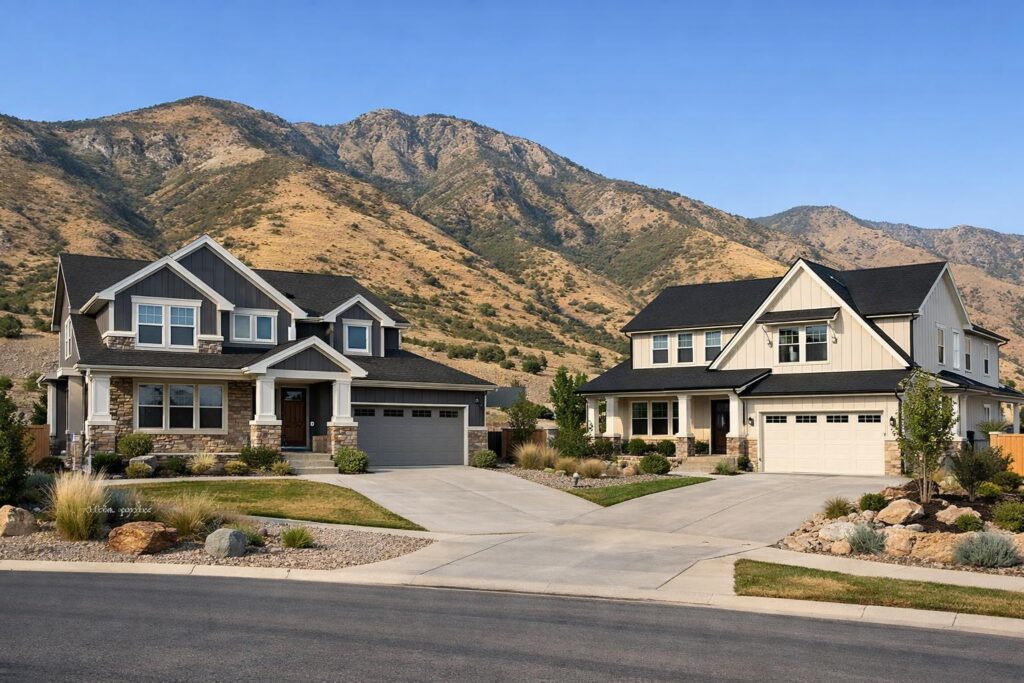

Buyers often ask me the same question after a Herriman showing: “Is there actually room to negotiate here, or are we about to make an offer the seller will ignore?” I do not answer that with a standard percentage. I start with what this particular home is asking you to accept—and what your other choices look like right now.
In Herriman, that may mean comparing a resale home with an inventory build, checking whether a “finished” basement received a final inspection, reading the parking and maintenance rules before calling a townhome inexpensive, or driving the route to Mountain View Corridor at the time you would actually use it. One clue gives us a question. Several facts pointing in the same direction can give us a position.
Four Signs I Take Seriously
A home may have room to negotiate when the case is specific enough that both sides can understand it. These are the four places I begin:
My rule: one signal is usually a reason to ask a better question. Two or three verified signals may support a different price, credit, repair request, or contract term.
- Why the address matters more than the headline
- How I compare real Herriman alternatives
- What listing history can tell us
- Local checks that can change the offer
- How seller priorities affect the deal
- How new construction changes the comparison
- The 15-minute offer worksheet
- Questions buyers actually ask me
Why the Address Matters More Than a Herriman Market Headline
Herriman is several housing markets sharing one city name. A newer townhome near a major corridor, a detached resale on an established street, a hillside home near open space, and an inventory home in an active builder phase can sit in a similar price range and still attract very different buyers.
Herriman City says about 41% of the community’s homes are townhomes or apartments, while roughly 14,000 additional homes have already been entitled to developers. Those figures help explain why buyers here can move between attached housing, detached resale, and new construction more easily than they can in some older communities. They do not prove that every seller has to negotiate.
What matters is whether the seller’s home has a close substitute for you. A lower-priced townhome is not leverage if you need a large yard and three-car parking. A resale home is not automatically the better value if it needs a basement finish, fence, window coverings, and landscaping that the competing inventory home already includes. I want the comparison to survive your normal week, not just look good on a spreadsheet.
This is where broad market language breaks down. “Herriman is growing” is context. “The closest completed alternative has the same bedroom count, a finaled basement, lower immediate work, and a similar payment” is an offer fact. The second statement can guide a decision.
The order I use
Start with the home. Then look at the two or three properties that could realistically replace it. After that, pull the local records, current project information, and seller details that affect this address. Citywide data belongs at the edge of the conversation—not at the center of the offer.
There is also an emotional side to this. A home can be imperfect and still be difficult to replace because it solves a rare layout, accessibility, location, school, yard, or timing need. When that is true, I would rather say it out loud than pretend we have more bargaining power than we do. A clear walk-away point is useful only when you are genuinely willing to walk.
Good negotiation is not about embarrassing the seller or “winning” every line item. It is about giving both sides a deal they can explain. That is the point of the first video below.
How I Compare Real Herriman Alternatives
I do not build a comparable set by square footage alone. I build a replacement set: the small group of homes you would truly consider if this seller said no. For most buyers, three serious alternatives tell us more than twenty loose matches.
That comparison needs to include the part of the home you will still be paying for after closing. List price is only the front door. The rest is financing, association dues, taxes, insurance, unfinished work, commute friction, maintenance, and the features you would need to add before the home functions the way you expect.
| Herriman comparison | What I would pull or test | What it may change |
|---|---|---|
| Resale versus inventory new construction | Written builder price, lot premium, upgrades, lender incentive terms, landscaping, fencing, appliances, completion date, warranties, and the resale home’s finished features | Whether the resale deserves a premium, needs an adjustment, or remains the better completed value |
| Townhome or condo versus detached home | HOA dues and documents, exterior maintenance, master insurance, parking rules, storage, yard use, stairs, guest parking, and the true monthly payment | Whether the lower list price is actually lower-cost ownership—and whether the home fits your daily routine |
| Finished basement versus unfinished or recently completed space | City permit and inspection history, final approval, bedroom egress, heating and electrical work, and whether a kitchenette creates an I-ADU question | How much finished space you are willing to pay for and whether the seller should resolve an open permit or documentation issue |
| South Herriman growth area versus an established pocket | Current phase map, nearby entitled land, road and utility work, planned commercial areas, construction traffic, open amenities, and what is only scheduled for later | How you value future convenience against present dust, noise, changing routes, and uncertainty |
| Hillside or open-space-edge home versus an interior lot | Drainage, retaining walls, slope usability, snow and sun exposure, wildfire and insurance questions, nearby trail access, and any mapped floodplain or infrastructure concern | Near-term ownership cost, insurance comfort, yard value, and the amount of specialist review you need |
| Similar home with a different route | Weekday drive at your actual departure and return times, school pickup traffic, legal turns and crossings, Mountain View Corridor access, backup routes, and guest parking | Whether the “better deal” costs too much time—or whether the target home’s location premium is justified |
Then I use a simple replacement test: Would you tour the alternative tomorrow? Would you make an offer if the target home disappeared tonight? Does it produce a comparable monthly cost and a life you would accept? If the answer is no, it should not be used to pressure the seller.
For the broader choice set, use my Herriman housing guide. For the numbers that hide behind list price, use the Herriman housing-cost guide. And when location is doing most of the selling, run the route through my Herriman commute test before deciding what the address is worth to you.
What Listing History Can Tell Us—and What It Cannot
A listing’s history is the story of how the seller has tested the market. It can show a high starting price, a reduction, a withdrawn and relisted period, a contract that fell through, or a home that has been available longer than its closest competition. That history gives us questions. It does not give us permission to invent the seller’s motive.
Public websites can display different day counts, and some changes can reset or separate the history a consumer sees. Before I draw a conclusion, I want the agent-facing status record, the current disclosures, the price-change dates, and the competing homes that were available during the same period.
What feedback keeps repeating?
If several buyers point to the same parking, condition, layout, yard, access, or price problem—and the issue remains—there may be a real gap between the seller’s position and the market’s response.
Did a prior contract reveal anything?
A fall-through is not automatic leverage. I want to know whether the issue involved the property, financing, appraisal, buyer circumstances, or something that has already been corrected.
What changed after the reduction?
A price cut can mean the seller is responding. It can also mean the seller believes the present price already accounts for the problem. We compare the new number with today’s alternatives.
What is competing now?
A resale may have sat quietly and then face a new builder release or several better-finished resales. The current choice set matters more than what was listed a month ago.
The most useful pattern is usually not “long days on market.” It is exposure plus unresolved friction plus credible competition. A home that has been available, still needs visible work, and now competes with better-completed choices presents a clearer case than a home with only one of those facts.
I also check for double counting. If the seller already reduced the price because the yard is unfinished, asking for the entire landscaping cost again may overstate the issue. The question is not whether you can name a flaw. The question is whether the home’s present price and terms still make sense beside the present alternatives.
The Local Checks That Can Change a Herriman Offer
The details that create room are often boring. They are not the mountain view or the quartz counters. They are the permit that never received a final, the parking rule buried in the association packet, the tax line nobody compared, or the future road shown on a city map behind the sales center.
Here are the Herriman-specific checks I would not skip when they apply to the property:
I move each concern through the same short path:
Use precise language. “The basement makes me nervous” gives the seller nothing to answer. “Herriman’s record does not show a passed final inspection for the finished area, so we need the approval documented or the unresolved status addressed in the offer” is specific.
The same applies to future development. “There is too much construction” is vague. “The city’s current plan shows a road connection and additional phases near this property, and we are assigning less value to the present setting until the access and timing are clearer” gives the concern a source and a consequence.
A low appraisal is another moment when the evidence—not panic—should control the next move.
Price Is Only One Part of the Seller’s Decision
Sometimes the best room is not in the price. A seller may care about closing before another purchase, staying in the home briefly after closing, avoiding another failed transaction, keeping or excluding a particular item, or knowing that the buyer’s financing can reach the finish line.
This does not mean giving away inspections, appraisal protection, title review, or financing safeguards just to look “clean.” It means finding the pieces that are valuable to the seller and genuinely manageable for you.
Ask a real question before guessing
Have the agents clarify timing, possession, included items, prior transaction issues, and anything the seller is willing to share. “Motivated” in a listing is not a strategy.
Decide what you will not trade
Set the due-diligence, financing, appraisal, title, document, and insurance protections your decision needs before the offer gets emotional.
Offer convenience only when it is truly low-cost
A flexible closing date may be easy. Post-closing possession may not be. Every timing arrangement needs written terms, insurance guidance, and a plan for responsibility.
Give the number a reason
Connect a price, credit, or repair request to the competing homes, written costs, inspection finding, permit status, association obligation, or unresolved local issue behind it.
Choose the counter before it arrives
Know which term can move, which number can move, and where the home stops beating your alternatives. That is how you stay calm when the seller responds.
A strong offer is not the one with the most concessions. It is the one where the price, terms, financing, and risk all tell the same story. The seller should be able to see why the offer is workable. You should be able to sleep after signing it.
Once those signals are clear, the next step is assembling the full offer without losing the protections that matter. My Herriman competitive-offer guide explains the preparation and communication around that part of the process.
How New Construction Changes a Herriman Resale Negotiation
Herriman buyers often have a choice that does not exist in the same way in older cities: a resale home may compete directly with an inventory build or a home in a future phase. That can create room, but only after the builder offer is converted from a brochure number into a completed-home number.
Herriman’s current South Herriman plans cover Rosecrest, Panorama, and South Hills. The city’s project page describes additional housing, road and utility work, future commercial areas, trail connections, and Panorama Park, which is scheduled for completion by the end of 2028. It also notes disclosure and sound-mitigation measures for designated high-noise areas near Camp Williams. In northwestern Herriman, Olympia is another phased development with housing, commercial areas, and open space planned over several years.
Those plans are useful, but I separate four different words: open, under construction, approved, and proposed. They do not carry the same value. A park you can walk to today belongs in the current comparison. A park scheduled for a later phase belongs in the future column, with the understanding that timing can move.
Transportation needs the same discipline. UDOT’s August 2026 update says the next major Mountain View Corridor freeway phase north of Porter Rockwell Boulevard is expected to begin in 2027. That may improve long-term regional movement while also bringing construction stages, lane changes, and route adjustments. I would not add or subtract a standard amount for that. I would test how the specific home connects to the corridor now and check the current project status before offering.
For the builder comparison, I want two lender scenarios side by side. A large preferred-lender incentive may be valuable, but it can be tied to a specific inventory home, closing window, interest-rate structure, or upgrade package. Compare cash to close, monthly payment, loan costs, and the period you realistically expect to keep the financing—not only the incentive headline.
Then price the unfinished pieces: lot premium, upgrades, fence, window coverings, landscaping, appliances, basement, storage, and the months you may spend around active construction. A resale may deserve more because those pieces are done. A new build may still be the better choice because the systems, warranty, or layout matter more. The comparison should reveal the tradeoff, not force a discount.
Herriman City currently reports about 55 miles of trails, including 30.8 paved miles. That is useful community context, but a citywide trail number does not tell you whether a particular front door has a safe, direct, practical connection. Check the actual path, crossings, grade, winter conditions, and whether the route is open now.
My Herriman future-development guide goes deeper on how to separate entitlement, approval, construction, and completion before you attach value to a future feature.
A listing’s response can tell a seller something, too. The third video is useful because it shows the other side of the negotiation: silence and repeated feedback are information, not insults.
The 15-Minute Herriman Offer Worksheet
Before I write, I want the decision to fit on one page. This is not a pricing formula. It is a way to keep the facts, the unknowns, the seller’s priorities, and your limit from getting mixed together.
| Write this down | What belongs there | What it decides |
|---|---|---|
| Why this home is hard to replace | The two or three things the home solves unusually well: location, layout, yard, accessibility, parking, timing, or a specific household need | How much negotiating room you truly have before the alternative becomes worse |
| Two real replacement homes | Current properties you would tour and buy, with full monthly cost and unfinished work included | Whether walking away is practical rather than theoretical |
| Herriman-specific checks | Permit/final status, HOA and parking, tax notice, school lookup, development map, route test, insurance question, or Camp Williams disclosure as applicable | Which facts need an answer before your deadline and which may support a request |
| Known cost or obligation | Inspection result, contractor quote, missing completion item, monthly fee, repair, or documented ownership cost | Whether price, credit, repair, or a lower walk-away point fits best |
| Seller’s confirmed priority | Timing, possession, certainty, included items, or another term actually communicated through the transaction | Which low-cost term may improve acceptance without increasing risk |
| Your response ladder | Opening position, acceptable counter range, protections that stay, and the point where the home no longer wins | What you will do when the seller accepts, counters, or says no |
Example only: You are comparing a detached resale with an inventory new build. The new build includes a lender incentive but still needs fencing and landscaping. The resale includes those items, but the basement permit record does not show a completed final inspection. The seller needs a later move. A coherent offer might keep your inspection and financing protections, ask for the basement status to be documented or addressed, and offer timing flexibility only after the possession and insurance details are clear. The point is not that this is the “right” answer. The point is that every term connects to a real fact.
Before submitting, read the page once for double counting. Did you reduce the price for the basement and also ask for the full cost to finish it? Did the builder comparison leave out the lot premium or lender fees? Did you call a nearby trail an advantage without walking the actual route? Did the prettier kitchen make a difficult commute disappear from the math?
Then plan the counter. Decide what can change, what cannot, and whether the home still beats your second choice at the likely middle point. That one step prevents more regret than trying to predict the seller’s personality.
My practical rule
Use the request that matches the evidence. Use price for a durable value difference, an allowed credit for a financing or closing-cost need your lender approves, a repair request for a defined condition item, documentation for an unresolved record, and a contract term for timing or certainty. If the issue cannot be measured or explained, it may belong in your walk-away decision rather than in a demand.
Local Sources Worth Opening Before You Call Something “Leverage”
Local research note: A local source check was completed on September 4, 2026 using Herriman City, UDOT, Salt Lake County, Jordan School District, and Jena Hunt’s existing Herriman guides. Listings, incentives, construction schedules, school boundaries, tax information, insurance conditions, and municipal records can change. Recheck the items that affect the property before writing the offer.
Questions Herriman Buyers Actually Ask Me
The listing has been sitting. How far below list can I go?
There is no honest percentage based on days alone. I would compare the current price with the closest replacements, check what changed during the listing, identify any unresolved property friction, and ask what the seller values now. The supportable number comes from that combination.
The basement looks finished. What would you check before paying for it as finished space?
I would ask for the permit and inspection history, confirm whether a final approval was issued, and have the relevant professionals evaluate the actual work. Herriman City says basement finishes normally require inspections and a passed final. A kitchen, kitchenette, or wet bar can also raise an I-ADU question depending on the setup and zoning.
A builder is offering a large incentive. Does that automatically give me leverage on a resale?
No. Put the builder offer in writing and compare the full deal: lender terms, cash to close, payment, lot premium, upgrades, landscaping, fence, appliances, completion date, HOA, warranty, and construction around the home. The incentive matters only after you know what it truly saves and whether you would buy that home.
Should a planned road, park, school, or commercial area change my offer?
It can change how you value the home, but first identify whether the feature is open, under construction, approved, entitled, or only proposed. Do not assign today’s value to a future amenity without considering timing, construction impact, and the possibility that plans change.
What should I check for a home near the Herriman foothills or open space?
Look at drainage, slope, retaining walls, access, trail use, wildfire and WUI information, and an address-specific insurance quote. Use the city maps and qualified professionals. A hillside location can be a major benefit, but it deserves a different due-diligence list than an interior lot.
Does the school named in the listing prove my child will attend it?
No. Use Jordan School District’s current address-based boundary lookup and confirm transportation information. School assignments and boundaries can change as the area grows, so recheck close to the offer rather than relying on the subdivision name or listing remarks.
Should I waive an inspection to make a Herriman offer stronger?
I do not treat an inspection waiver as a routine shortcut. The right protections depend on the home, your financing, and your tolerance for unknowns. Talk through inspection, due diligence, appraisal, title, document, insurance, and financing terms with the professionals responsible for those areas before changing them.
What should I send Jena for an offer review?
Send the listing link, your lender’s property-specific estimate, the two alternatives you would actually pursue, available disclosures and HOA documents, what is making you hesitate, and the maximum monthly or total cost that still feels comfortable. I can then tell you what we know, what needs to be pulled, and which questions belong in the offer conversation.
Want Me to Pressure-Test a Herriman Listing?
Send me the listing and tell me what is making you pause—price, basement status, HOA rules, builder competition, commute, insurance, or development nearby. I’ll help you separate a real negotiating signal from a detail that only sounds important, then map the next question before you commit.