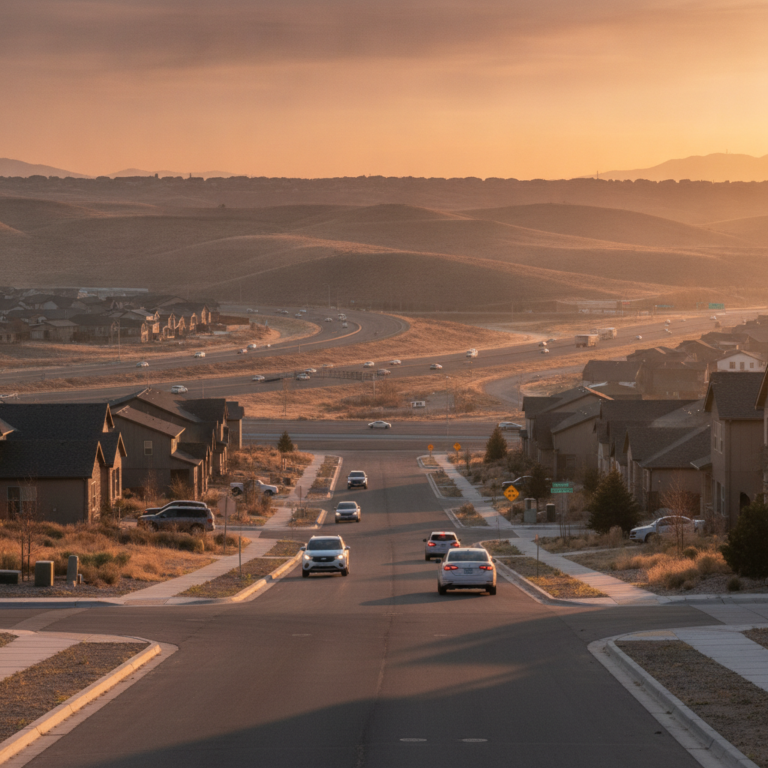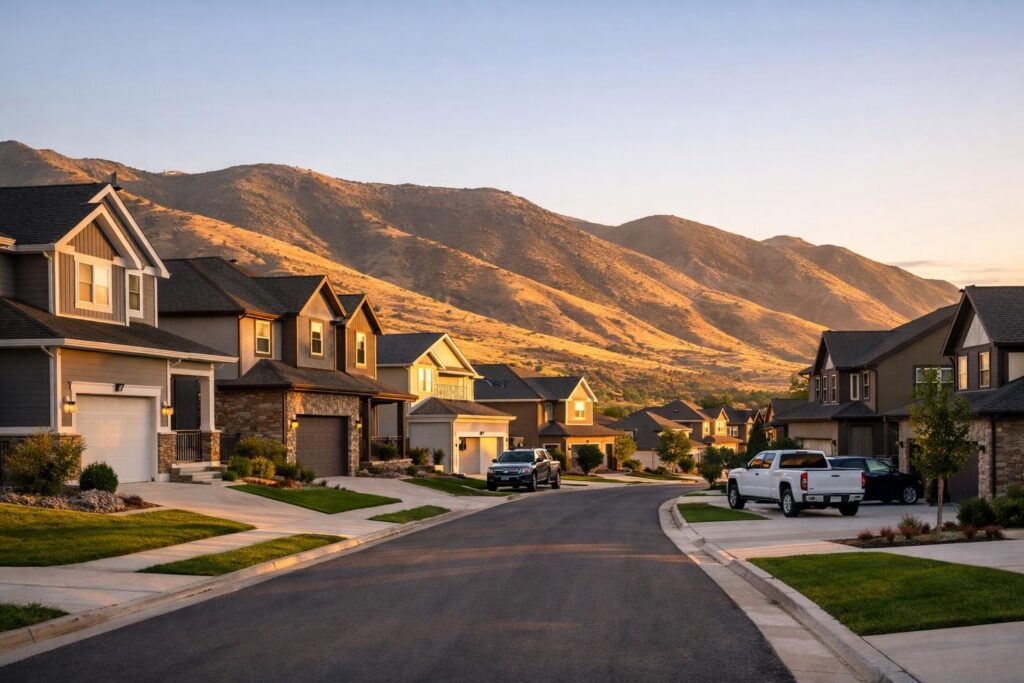
Does a Herriman home that looks close to Mountain View Corridor automatically give you an easy commute? No. Map distance is not the commute. Your useful number comes from the exact driveway, the feeder streets, the interchange or legal crossing you can actually use, the destination, and the real departure and return times you live with.
I would test that route more than once before I let a commute claim influence an offer. Herriman’s corridors matter, but they do not erase the first and last part of the trip.
What Should You Measure Before Buying in Herriman?
Measure the whole household route—not just miles to a major road. Use the exact address, your real destination, repeated weekday tests, the return trip, and the stops that make the commute more than a straight drive.
Why Does Map Distance Undersell the Real Herriman Commute?
A listing can be factually close to a major corridor and still require a meaningful local trip to reach it. That local trip is where many comparisons break down.
Start at the driveway. Which direction can you legally turn? How many signals or roundabouts sit between the home and the corridor? Does the route pass a school arrival area, a construction phase, a narrow connection, or a street that carries neighborhood traffic toward the same exit?
Then look at the corridor connection. Mountain View Corridor access is not the same as seeing the road from the neighborhood. Bangerter Highway access is not the same as living near 13400 South. The usable ramp, interchange, and direction matter.
Finally, use the destination you actually need. A commute to Draper, Lehi, downtown Salt Lake City, Daybreak, an airport shift, a school, or a rotating job site can favor different routes. A citywide average cannot settle any of those trips.
| Commute layer | What to record | Why the layer changes the result |
|---|---|---|
| Home exit | Driveway direction, neighborhood exit, first signal, and alternate exit. | A home with one practical way out can behave differently from a similar-distance home with two. |
| Feeder route | Local streets, school zones, construction, turns, and the time needed to reach the corridor. | This is the part a “minutes to highway” phrase often skips. |
| Major corridor | Mountain View Corridor, Bangerter, Redwood Road, 12600 South, or another route actually used. | Each corridor points toward different destinations and connections. |
| Destination approach | Last interchange, surface streets, parking, and arrival deadline. | The final miles can be the least predictable part of the trip. |
| Household stops | School, childcare, partner handoff, errands, and evening commitments. | Your real commute may be a chain of stops, not one origin and one destination. |
I would not use a quiet Sunday drive as the answer to a weekday question. I would also avoid testing one home at 10:30 a.m. and the next at 5:15 p.m. Use comparable windows so the result tells you something.
How Does Mountain View Corridor Access Vary by Herriman Pocket?
UDOT describes Mountain View Corridor as an eventual 35-mile freeway from I-80 in Salt Lake County to SR-73 in Utah County. “Eventual” matters. The corridor has open segments and phased future work; it should not be described as a fully completed freeway along its entire planned length.
For a Herriman buyer, the useful question is where the home connects to the corridor now.
A western or southern Herriman address may look closer to the corridor on a map. That does not tell you whether the most useful connection sits north, south, or across a local route that adds time. Porter Rockwell Boulevard is an important orientation point in UDOT’s next planned freeway-conversion phase toward Old Bingham Highway, but planned work is not a current commute benefit.
UDOT has said the next conversion phase is expected to begin construction in 2027. That wording should stay intact. Expected timing can change, and construction itself can create a different route condition before a later improvement is complete.
I would evaluate a Mountain View Corridor home in four steps:
- Identify the current connection you will use in the morning.
- Identify the current connection you will use on the return trip.
- Check whether active or planned work affects either route.
- Decide whether the home works with today’s network before giving future work any credit.
The last step protects you from buying a current commute based on a future road story.
Western pocket
Do not stop at corridor proximity. Time the local connection to the usable access point in the direction you travel.
Southern pocket
Use Porter Rockwell Boulevard and the current route network as orientation, then separate open roads from future conversion work.
Central pocket
Compare the route to Mountain View Corridor with alternatives toward Bangerter, Redwood Road, or 12600 South.
Growth-edge pocket
Check temporary construction access, unfinished connections, and whether the neighborhood relies on one current exit.
These are route questions, not neighborhood rankings. Two homes in the same broad pocket can still have different access because of street layout, phase boundaries, and legal turns.
What Should You Expect From Bangerter Highway Access?
Older commute advice can become stale quickly when a major project changes status. UDOT announced completion of freeway-style interchanges at 4700 South, 9800 South, 13400 South, and 2700 West in November 2025. The UDOT completion release confirms that 13400 South is no longer an active interchange-construction story from an earlier period.
That does not mean every Herriman address gained the same commute.
You still have to reach 13400 South or another Bangerter connection from the home. The neighborhood feeder, direction of travel, signals, school activity, and the route to the destination remain part of the trip. A completed interchange can improve the network without producing one universal time savings.
Here is what I would test:
- The fastest current route from the listing to the interchange at your departure time.
- Whether the return route uses the same streets or sends you through a different approach.
- How a school-day morning compares with a non-school weekday.
- Whether a second route exists when an incident affects the primary one.
- Whether your destination is better served by Bangerter at all.
Do not name a permanent bottleneck from one bad drive. Incidents, weather, event traffic, and temporary work can create a bad day. Repeat the test and separate recurring route behavior from a one-time problem.
What Public Transit Options Exist—and What Are Their Limits?
UTA Route 126 is a real fixed-route option through the broader 12600 South corridor. The current Route 126 schedule page lists Herriman City Hall and SLCC Herriman Campus among its timepoints and connects toward Draper Town Center and Daybreak Parkway TRAX stations.
That establishes an option. It does not prove the option works for your job.
Transit fit depends on the complete itinerary:
- How you reach the stop from the home.
- The day and time service operates.
- The wait before the first vehicle.
- Any transfer to TRAX, another bus, or a final connection.
- The time you must arrive at work.
- The return trip and the last practical connection.
- What happens when your schedule changes or you stay late.
I would run the current trip planner for a normal workday, then physically test the first and last mile. A stop on a map can still require a drive, a difficult crossing, or a walk that does not fit winter weather or your schedule.
Transit can also work differently for different days. A hybrid worker may use it once or twice a week. Another person may use it only as a backup. Decide what role it needs to play before you give a nearby route extra weight.
Source basis: The corridor and transit facts in this guide come from UDOT’s Mountain View Corridor project information, UDOT’s 2025 Bangerter interchange completion notice, and UTA’s current Route 126 page. Those sources establish network status and available service. They do not guarantee a commute time, transfer, seat, schedule, walkability result, or future time savings from a Herriman address.
How Walkable or Bikeable Is Herriman Itself?
There is no honest citywide answer for a specific home.
Herriman has sidewalks, trails, parks, schools, civic destinations, and growing commercial areas. The usefulness of those elements changes by address. A trail may sit nearby without a legal connection. A destination may be a comfortable ride for one person and an unsuitable crossing for another. Winter conditions and darkness can change the same route.
I would verify:
- Sidewalk continuity from the property.
- Legal crossings at the roads you need to cross.
- Trail entrance rather than the nearest trail line.
- Surface, grade, lighting, and seasonal maintenance.
- Bike storage and equipment setup at the home.
- The return route after dark or in poor weather.
Do not use a neighborhood-wide walk score as a substitute for the route you care about. The useful question is whether you can reach the exact destination in the way you plan to travel.
How Do You Test Your Actual Commute Before Buying?
Run the same commute experiment from every serious listing. The goal is not to produce a permanent promise. It is to compare homes under similar, realistic conditions.
Choose the exact destination
Use the real workplace entrance, parking location, campus, job site, or transit connection.
Use the actual departure time
Leave when you would normally leave. Do not shift the test to a quieter window because it is more convenient.
Include the first stop
Add school, childcare, coffee, a partner handoff, or any stop that is part of the regular morning.
Record the route, not only the minutes
Note the home exit, feeder streets, corridor access, destination approach, and where delay occurred.
Repeat on comparable weekdays
Two or three tests can show variability. Label unusual weather, incidents, school closures, or events.
Test the return trip
Use your normal departure from work and add evening stops or activities that affect the route.
Run the alternate route
Know whether a realistic backup exists when the primary corridor has an incident or temporary closure.
Keep a simple log:
| Field | What to write down | Why it helps |
|---|---|---|
| Date and day | Comparable weekday and whether school was in session. | Prevents unlike conditions from being treated as the same test. |
| Departure | Actual time from the driveway and any first stop. | Shows how much of the trip occurs before the main corridor. |
| Route | Feeder streets, corridor, interchange, and destination approach. | Makes it possible to compare where two homes differ. |
| Condition | Normal, incident, weather, construction, event, or unusual delay. | Keeps a one-time disruption from becoming the permanent story. |
| Return | Departure from work, stops, arrival, and alternate route. | Captures the half of the commute that listing descriptions usually ignore. |
Then compare the commute with the home itself. A slightly longer route may be an acceptable trade for layout, budget, workspace, or maintenance. A shorter route may be worth more to someone who drives it five days a week. The answer depends on your schedule.
Use the Herriman transportation and accessibility guide for the broader network, then use the Herriman community guide to place the route beside schools, amenities, services, and growth.
My practical rule: I would not call a Herriman commute easy, short, or realistic until I have tested the exact address, destination, time, return trip, and household stops under comparable weekday conditions.
The better Herriman commute choice is not always the home that produced the lowest number once. It is the home whose routes, backups, and daily sequence give you the amount of reliability you need.
Your notes describe what you observed on specific dates. They do not guarantee a future travel time. Road projects, incidents, weather, school schedules, and daily demand can change the trip. Use current official project and transit sources for status, then use repeated field tests for your decision.
Do not convert a route test into a guarantee
For two working adults, put both schedules on one page. The home that shortens one route can lengthen the other or complicate childcare. Compare the household week, not only the loudest commute concern.
If remote work is part of the backup, verify the home-office room and address-level internet options. A spare bedroom shown in listing photos is not automatically a workable office when the rest of the household is active.
A household with a fixed start time needs a different margin than someone who can shift a meeting or work remotely. Count how many days each route is required. A longer trip once a week and a slightly shorter trip five days a week should not carry the same weight.
Give schedule flexibility a value
A park-and-ride or drop-off can change the first mile. So can a bicycle or a second household vehicle. Compare the arrangement you would genuinely use, not the most optimistic itinerary available on paper.
For each home, identify how you reach the stop, the current service day and schedule, transfers, the walk or ride from the final stop, and the latest practical trip home. If a missed connection would make the day unworkable, record that as part of the decision.
UTA Route 126 creates a transit option through Herriman, including stops at Herriman City Hall and SLCC Herriman Campus, with connections toward Draper Town Center and Daybreak Parkway. That is useful network context. It is not a universal commute answer.
Build a transit comparison from the complete itinerary
The last mile matters, too. Include the surface streets near the workplace, parking, and the time needed to reach the actual start of your day. A regional corridor is only one part of the trip.
How many neighborhood exits work today? Which direction can you turn at the hour you travel? Does the route depend on one intersection? Is a future connection being treated as though it already exists? Those questions keep “close to the corridor” from becoming an unsupported convenience claim.
Mountain View Corridor or Bangerter Highway can dominate the conversation because they are the recognizable regional routes. The address-level difference often appears before you reach them.
Measure the first and last mile carefully
Do the same for the return. A home that feels simple in the morning may require a different series of turns after work. Add the stop you usually make on the way home rather than testing an idealized direct trip.
Repeat the route more than once when the commute is a major decision factor. You are looking for the pattern, not a perfect number. Record where the route slows, how many route choices exist, and whether a delay in the first segment leaves you with another option.
Test both homes on comparable weekdays, at the time you would actually leave. Use the same workplace entrance and parking destination. If one test ends at the edge of a business district and the other ends at your building’s garage, the results are not comparable.
Use comparable days and the same destination
| Reliability line | What to record | Why it matters |
|---|---|---|
| Driveway to corridor | Neighborhood entrance, feeder roads, signals, turns, school zones, and alternate exit. | A home can be near a major route and still have a fragile first segment. |
| Corridor choice | Mountain View Corridor, Bangerter Highway, Redwood Road, 12600 South, or another current path. | The useful corridor depends on the destination and the part of Herriman where the home sits. |
| Connected stops | School, childcare, fuel, groceries, partner handoff, or another recurring stop. | The real commute is often a chain, not a direct home-to-office trip. |
| Return trip | Departure time, route, stop sequence, and the final neighborhood entrance. | The evening version may create a different decision from the morning. |
| Backup | Second driving route, remote-work option, transit itinerary, or schedule flexibility. | A workable backup can matter more than the fastest single result. |
| Change check | Current construction notices, route updates, and the date tested. | Road conditions and projects change; a dated test prevents false certainty. |
Do not start by asking which home is “closer.” Start by asking which home gives you the more workable sequence on the days that matter.
One drive can tell you what happened once. It cannot tell you how dependable the route will feel across your week. When two Herriman homes are close in price or layout, I would compare the commute as a system: driveway access, feeder streets, corridor choices, connected stops, backup options, and the return home.
How Do You Compare Two Herriman Homes on Commute Reliability, Not One Test Drive?
Frequently Asked Questions About Commuting From Herriman
What is the average Herriman commute time?
Citywide averages cover many destinations and schedules, so they cannot predict your trip. The useful answer comes from testing the exact home-to-destination route at your real departure and return times.
Is every western Herriman home convenient to Mountain View Corridor?
No. Proximity to the corridor does not show the feeder route, usable access point, direction, construction condition, or destination. Test the driveway-to-corridor portion.
Is the Bangerter Highway interchange at 13400 South still under construction?
UDOT announced completion of the freeway-style 13400 South interchange in November 2025. Current incidents and nearby work can still affect a route, so check live conditions when you test.
Can I commute by public transit from Herriman?
UTA Route 126 provides a fixed-route connection through Herriman toward Draper Town Center and Daybreak Parkway. Whether it works for you depends on stop access, schedule, transfers, arrival time, and the return trip.
How many times should I test a commute before offering?
I would test on at least two or three comparable weekdays when the route materially affects your decision. Use the same departure window and record unusual incidents or weather.
Does a future road project guarantee a shorter commute?
No. Keep planned and expected projects separate from current conditions. Buy only when today’s route works for you without a promised future time savings.
What Route Can You Not Afford to Underestimate?
Send me the exact Herriman address, destination, and schedule. I will help you identify the feeder route, current corridor choices, transit questions, and the parts of the commute that still need a real-world test.
No optimistic map shortcut. Just a direct comparison before you narrow the search.