
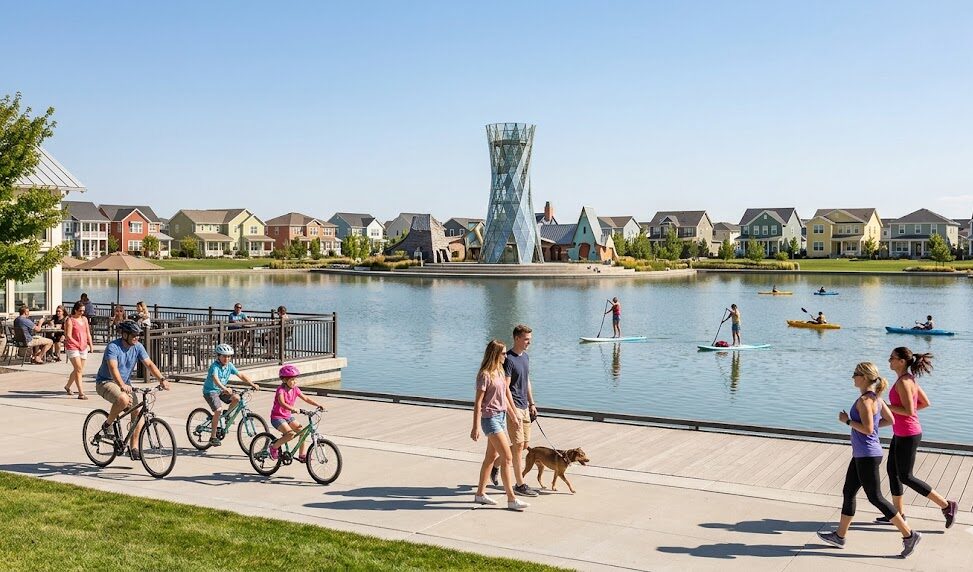
My quick answer: Daybreak is best for people who want their neighborhood to do more than hold a house. If you like walkable trails, planned parks, community events, shared amenities, lake-oriented routines, and a more structured neighborhood environment, Daybreak can feel incredibly convenient. If you want fewer rules, more separation, fewer shared spaces, or a less planned feel, we should look carefully at the specific pocket before you commit.
When I help someone think through Daybreak, I do not start with square footage. I start with your week: where you work, how often you drive, how you spend evenings, how much maintenance you want, whether you like community energy, and how comfortable you are with HOA structure.
Daybreak is a master-planned community within South Jordan, so hard demographic numbers are best anchored to South Jordan city-level sources, while Daybreak lifestyle context comes from official Daybreak and LiveDAYBREAK community sources. Confirm address-level details such as HOA rules, school boundaries, amenities access, and development impacts before making a purchase decision.
Daybreak demographics: what the numbers can and cannot tell you
People search for “Daybreak demographics” because they want to know who lives here, how the community feels, whether it is family-oriented, and whether they will feel at home. That is understandable. But we need to be careful: Daybreak is not its own city with a simple Census profile. It is a large master-planned community inside South Jordan.
So the most honest way to read the data is this: use South Jordan as the city-level demographic anchor, then use Daybreak-specific lifestyle signals to understand how daily life may feel in different pockets.
- South Jordan City Economic Development Quick Facts: population, median age, median household income, household size, home value, and dwelling-unit context. South Jordan City
- U.S. Census Bureau QuickFacts for South Jordan: income, labor force, commute time, and household data. U.S. Census Bureau QuickFacts
- Official Daybreak amenities and LiveDAYBREAK community sources for lifestyle, amenities, HOA/community operations, and resident programming context. Daybreak Amenities and LiveDAYBREAK
What can you safely infer from the local data?
South Jordan’s demographic profile points to a growing, higher-income, family-capable city with a relatively young median age and a strong owner-occupancy/home-value environment. But it does not tell you whether one Daybreak pocket feels quieter, busier, more walkable, more family-oriented, or more low-maintenance than another.
That is where the local lifestyle evaluation matters. I would not want you to buy based on a city-wide number and then discover that the street, HOA setup, parking pattern, commute route, or nearby construction phase does not fit your real life.
| What you want to know | Best source | How to use it |
|---|---|---|
| City-level demographics | South Jordan City and Census QuickFacts | Use this for population, income, household size, median age, commute context, and broader market profile. |
| Daybreak lifestyle | Daybreak/LiveDAYBREAK sources and in-person visits | Use this for parks, trails, amenities, lake access, events, HOA/community operations, and daily rhythm. |
| Street-level fit | Actual showing, route testing, HOA documents, school boundary checks | Use this before writing an offer. This is where “looks good online” becomes “works for my week.” |
What daily life in Daybreak usually comes down to
Daybreak is designed around the idea that your neighborhood can shape your routine. That can be a big plus if you want daily movement, community programming, parks, trails, dining, and lake-oriented activities to be close by. It can also be a mismatch if you want a more unstructured, private, or rural-feeling setting.
For you, the useful question is not “Do people like Daybreak?” The useful question is: what do you want to be easy every week?
Question: Do you want your neighborhood to encourage movement?
If yes, Daybreak can be a strong fit. Oquirrh Lake, trails, parks, and connected community spaces are part of the appeal. But you still need to check the exact address. A home that looks close on a map may not feel equally easy once you test crossings, parking, shade, winter comfort, and actual route continuity.
Question: Do you like community energy?
Daybreak’s lifestyle is not only about houses. It is also about events, shared amenities, public spaces, and visible neighborhood activity. Some people love that. Others prefer quieter separation. Neither preference is wrong — but we should name it early.
Question: Do you want structure in exchange for consistency?
HOA structure, design standards, common-area maintenance, and community rules are part of the planned-community model. For some homeowners, that feels like convenience. For others, it feels restrictive. Before you fall in love with a property, I’d want you to understand what the HOA covers, what it restricts, and what it costs.
Official Daybreak materials describe Oquirrh Lake as a 67-acre freshwater lake surrounded by trails, parkland, and lakeside homes. LiveDAYBREAK also identifies the Association’s role in amenities, common areas, community standards, governance, dues, and maintenance. Always verify current amenity rules and HOA documents for the specific property.
The lifestyle patterns I would look for before choosing a Daybreak home
Instead of asking whether Daybreak is “good,” I like to separate the lifestyle into patterns. This makes the home search more practical and a lot less emotional.
| Lifestyle pattern | What it may feel like | What I would verify with you |
|---|---|---|
| Walkability-first | You want trails, parks, lake loops, and simple outdoor routines to be part of your week. | Can you comfortably walk the route from the exact home? Are crossings, lighting, shade, and winter conditions workable? |
| Community-event rhythm | You like the idea of events, neighborhood activity, and shared spaces that make the community feel alive. | Are you close enough to participate easily, but not so close that noise or parking bothers you? |
| Low-maintenance living | You prefer townhome, condo, or HOA-supported living because you want less yard and exterior upkeep. | What exactly does the HOA handle? What are the fees, rules, parking policies, rental policies, and pet rules? |
| Design-and-structure preference | You like planned-community consistency, streetscape standards, and a neighborhood that feels intentionally designed. | Do the rules feel like protection or limitation to you? That answer matters before you buy. |
| Family-routine fit | You want parks, school rhythm, activities, and commute timing to work together without daily stress. | School boundaries, commute times, drop-off/pickup routes, and after-school travel should all be tested. |
Housing type is part of the lifestyle decision
In Daybreak, the type of home you choose often shapes the way the community feels. A single-family home, townhome, condo, and new-construction property can all be “Daybreak,” but they do not create the same day-to-day life.
| Home type | Likely lifestyle advantage | Possible tradeoff |
|---|---|---|
| Single-family home | More private space, more storage, stronger home-base feel, and often more separation. | More maintenance responsibility, potentially higher cost, and pocket-by-pocket walkability differences. |
| Townhome | Lower-maintenance lifestyle, easier lock-and-leave rhythm, and often stronger proximity to community features. | Shared walls, parking rules, HOA rules, guest parking constraints, and less yard flexibility. |
| Condo | Convenience, simplicity, and reduced exterior upkeep. | Building rules, HOA fees, pet/rental restrictions, storage limits, and potential noise considerations. |
| New construction | Newer systems, fresh finishes, and a chance to buy into a developing pocket. | Construction timing, nearby development, temporary noise, changing roads, and future amenity assumptions. |
That is why I would not only ask, “How many bedrooms do you need?” I would also ask, “How much maintenance do you want? How much privacy do you need? How much HOA structure feels comfortable? How much parking do you realistically need? And what do you want to be walkable?”
Who Daybreak tends to fit best
I would never tell you a community is “for” one type of person. That is not useful, and it is not how real life works. But I can tell you the patterns I’d listen for when helping you decide whether Daybreak belongs on your shortlist.
If you are relocating
Daybreak can be attractive because it gives you a clear lifestyle framework. You can see the trails, parks, lake, shopping areas, and community rhythm quickly. But I’d still ask you to test the commute, school rhythm, and HOA structure before you treat it as a done deal.
If you are comparing Daybreak to other Salt Lake County communities
Daybreak may feel more intentionally planned and amenity-driven than many traditional neighborhoods. That can be a benefit or a drawback depending on your personality. If you are also looking at Herriman, South Jordan outside Daybreak, Riverton, or Bluffdale, the comparison should be about routine, not just price.
If you are buying for long-term fit
Think about what your life may look like in three to five years. Work location, children’s schedules, aging parents, remote work, pets, hobbies, and maintenance tolerance can all change how a Daybreak property feels over time.
The questions I would ask before you buy in Daybreak
If we were sitting together looking at listings, this is the checklist I’d want in front of us. It keeps the decision practical and protects you from buying based only on a beautiful showing.
| Question | Why it matters | How to verify it |
|---|---|---|
| What is your true commute? | Map estimates can miss peak-hour patterns and school-day timing. | Drive it twice: one normal weekday morning and one normal weekday evening. |
| What do you want to walk to? | “Walkable” only matters if it connects to your actual habits. | Walk the route from the front door, not from the general neighborhood. |
| How much HOA structure feels comfortable? | HOA can simplify maintenance or feel restrictive depending on your expectations. | Read the CC&Rs, design guidelines, fee schedule, parking rules, and amenity rules. |
| What is the parking reality? | Guests, teenagers, work vehicles, and townhome/condo rules can change daily convenience. | Visit at night and ask for current parking policies. |
| What development is nearby? | Future growth can improve amenities but also create construction noise or traffic shifts. | Check city planning updates, builder timelines, and the specific pocket’s future surroundings. |
| What schools and boundaries apply? | Boundaries can change, and assumptions can be wrong. | Verify with official school boundary tools for the exact address. |