Daybreak Amenities & Attractions — Trails, Pools, Oquirrh Lake & HOA Rules
Are you looking at Daybreak and wondering whether the lake, trails, parks, pools, The Watercourse, events, and Downtown Daybreak energy will truly improve your week? That is the right way to think about amenities. In Daybreak, “things to do” is not just a lifestyle question. It is a housing question, because the best amenity is the one you will actually use when life is busy.

My quick answer: Daybreak amenities matter most when they reduce friction in your ordinary week. A beautiful lake, a long trail system, a pool, a park, or an event calendar sounds good on paper. But the real question is whether that amenity is close enough, easy enough, and natural enough for you to repeat when you are tired, busy, cold, rushing, or managing kids, pets, work, and errands.
I would not choose a Daybreak home only because the community has impressive amenities. I would choose the home whose exact pocket gives you the amenities you will actually use. The difference matters. “Daybreak has trails” is general. “This home has a comfortable 8-minute route to the loop I will walk three times a week” is useful.
This page uses official Daybreak, Daybreak Community Association, Downtown Daybreak, UTA, and community resources as context. Amenity access, hours, HOA rules, seasonal closures, event schedules, pool rules, lake policies, trail conditions, parking, and transit schedules can change. Verify details for the exact address and the specific amenity that matters to your decision.
Sources checked: Daybreak amenities and FAQ pages, Daybreak Community Association benefits, MyDaybreak amenity access and guest-pass rules, Downtown Daybreak events/entertainment pages, and current South Jordan/UTA transit context.
- What changed in this update: Added an amenity access/rules table, a Daybreak pocket comparison, a household amenity-value test, a one-hour test route, and current Downtown Daybreak/TRAX context.
- What to re-check before buying: HOA fee, sub-association rules, guest passes, pool hours, lake/watercraft rules, Watercourse status, event schedules, parking, and the exact route from the home.
Daybreak amenities snapshot: what is useful, not just impressive
Daybreak is known for outdoor amenities, community design, and a more connected neighborhood feel than many traditional suburbs. Official Daybreak materials reference Oquirrh Lake, The Watercourse, parks, trails, pools, sports courts, community spaces, Downtown Daybreak, dining, entertainment, and resident benefits through the Daybreak Community Association.
That is the big-picture appeal. But I want you to think smaller and more personally: Which of these features will change your Monday through Thursday? Which ones will your household use without making a big plan? Which ones will still matter in winter, during school, after work, and when your schedule is already full?
My advice is simple: do not rank Daybreak amenities by what sounds best. Rank them by what your household will repeat. A nearby trail you use four times a week can matter more than a headline feature you visit twice a year.
Daybreak pocket comparison: amenity value changes by location
Daybreak amenities are not equally convenient from every home. A home near Oquirrh Lake, a home near a pool, a home near Downtown Daybreak, and a home in the Upper Villages can all be “in Daybreak,” but they can support very different weekly routines.
Use this as a starting framework, then verify the exact address, village, sub-association, walking route, parking pattern, and amenity rules before you treat any feature as part of the home’s value.
| Daybreak pocket / influence area | Amenity feel | Best fit | What to verify |
|---|---|---|---|
| Oquirrh Lake / Lake Village / The Island influence | Lake paths, water views, paddling, walking loops, and a stronger outdoor-lifestyle identity. | Buyers who want lake-centered routines, walking, running, paddling, or scenic daily resets. | Resident-only versus public areas, watercraft rules, guest rules, foot traffic, parking, and event patterns. |
| Eastlake / Founders Park / established Lower Village areas | More established parks, pools, community-center access, gardens, trails, and neighborhood routines. | Households that want existing amenities and a mature-feeling amenity network. | Pool distance, seasonal hours, trail route, school route, guest parking, and HOA documents. |
| Creekside / Highland Park / Heights influence | Parks, pools, sports courts, dog-park access, play spaces, and practical outdoor routines. | Families, dog owners, park users, and buyers who want repeated outdoor use more than headline amenities. | Noise, park activity, crossing comfort, shade, winter route conditions, and parking during busy periods. |
| Garden Park / SpringHouse 55+ areas | More age- and lifestyle-specific amenities, quieter recreation, clubhouse/pool access, and lower-maintenance living. | Downsizers and 55+ buyers who want community amenities without as much private-yard responsibility. | Age/community rules, sub-association fees, access rights, guest rules, and resale audience. |
| Upper Villages / Watercourse / Cove House influence | Newer-growth feel, Watercourse access, The Loop, The Spoke, and developing amenity patterns. | Buyers comfortable with growth phases who want newer housing and emerging recreation access. | Current construction, Watercourse status, resident-only rules, route completion, noise, and future phases. |
| Downtown Daybreak / Ballpark District / South Station influence | Dining, shopping, events, baseball, entertainment, TRAX access, and a more active destination feel. | Buyers who want activity nearby and are comfortable with a busier, event-influenced environment. | Event-day traffic, sound, lighting, parking, walkability, station access, and how close feels right. |
Start with the right question: what will you actually use weekly?
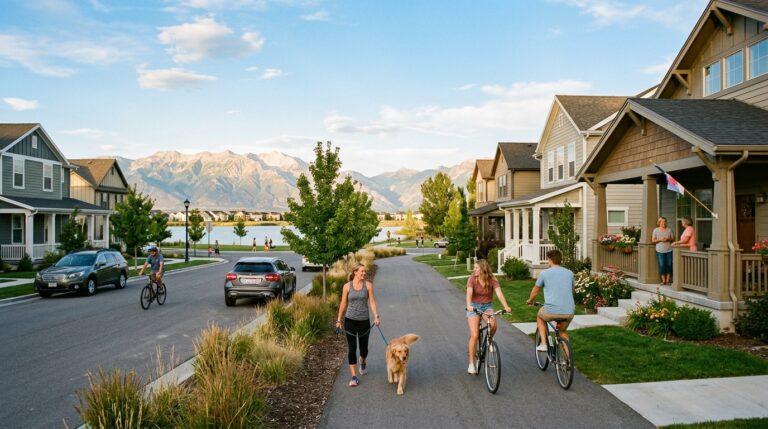
People often over-plan for weekends and under-plan for Tuesday. The amenities that change your quality of life are usually the ones that make ordinary days easier: a walk after dinner, a park after school, a quick ride to a favorite path, a pool your kids will use often, or a default dinner option that does not require driving across the valley.
The best Daybreak amenity decision starts with your real habits, not a community brochure.
- Pick one weekly habit you want to make easier.
Walking, running, biking, stroller loops, playground time, after-school outdoor time, quick dinner, community events, or low-maintenance recreation. - Map the 10–15 minute radius from the exact address.
Do not map from “Daybreak.” Map from the front door of the home you are considering. - Test the route at the time you would actually use it.
A perfect Saturday afternoon does not tell you what a winter evening or school-night walk feels like. - Verify access rules and seasonality.
HOA-controlled facilities, pools, lake use, resident-only features, event access, and parking rules can matter. - Ask the Tuesday test.
Is this easy enough that I would still do it when I am tired and busy?
Are Daybreak amenities worth it for your household?
Amenity value is personal. A household that uses trails, pools, lake paths, fitness spaces, events, and community programming every week may experience Daybreak very differently from a household that mostly wants a private yard and fewer rules.
| Likely strong value if… | Verify carefully if… |
|---|---|
| You use parks, trails, lake paths, pools, courts, events, or community spaces weekly. | You mostly stay home, prefer private outdoor space, or rarely use shared amenities. |
| You like planned-community design, architectural standards, and maintained common areas. | You dislike HOA structure, exterior rules, guest policies, rental restrictions, or approval processes. |
| You want a walk/bike routine and are choosing a home with an easy route to the amenity you care about most. | The home is technically “near” an amenity but requires awkward crossings, driving, or parking every time. |
| You value community programming, concerts, dining, baseball, and destination energy near home. | You are sensitive to event traffic, sound, lights, parking pressure, or busy public spaces. |
| You are comfortable paying HOA/sub-association costs because the included services replace things you would otherwise pay for or maintain yourself. | You are stretching your monthly payment and have not yet modeled HOA fees, sub-association fees, utilities, insurance, and maintenance. |
Daybreak parks and trails: what matters more than “nearby”
Most communities can say they have parks. What makes Daybreak different for many residents is the connected outdoor system: trails, parks, lake paths, neighborhood routes, and community nodes that can become part of daily life. But “near a park” is not enough. The real question is whether the park or path is usable from the exact home.
A route can be close but still not work. It may have uncomfortable crossings, poor lighting, a windy stretch, a snow/ice issue, or just enough friction that you stop using it after the first month.
| What to evaluate | Why it matters | What I would test |
|---|---|---|
| Route continuity | If the route breaks or feels awkward, you will use it less. | Walk the full route. Look for sidewalk gaps, crossings, construction, grade changes, and uncomfortable turns. |
| Comfort at real times | Comfort decides whether a habit repeats. | Visit early morning, after work, after sunset, or during the time you would actually go. |
| Kid-friendly design | Parents repeat what feels easy, visible, and manageable. | Check sightlines, traffic exposure, bathrooms if relevant, shade, seating, and whether play spaces feel contained. |
| Parking versus walking | If you have to drive to every park visit, the amenity feels different. | Decide whether walking, biking, stroller access, or parking is the practical plan from that home. |
| Seasonal usability | A summer-perfect route may not work the same in winter. | Ask about snow, ice, wind, early darkness, shade, and whether you have an indoor fallback. |
Question: What are the best parks in Daybreak?
The best park is the one your household will actually use. For one buyer, that may be a playground close to home. For another, it may be trail access, lake proximity, sports courts, or a quiet pocket park that makes evening walks easy.
Question: Should I pay more to be near a park or trail?
Maybe, if the access is truly useful and not disruptive. I would test noise, parking, traffic, and activity level before assuming proximity is automatically better.
Oquirrh Lake: beautiful, useful, and worth verifying
Oquirrh Lake is one of the features people associate most strongly with Daybreak. For some buyers, it becomes a daily anchor: walking, running, biking, taking kids outside, meeting friends, or simply having a place to reset. For others, it is nice to have but not something they use often. The difference usually comes down to access from the exact home.
Daybreak’s FAQ says Oquirrh Lake is a Daybreak resident amenity and is not open to the public, while the trail system and parks around the lake are open to the public. That distinction matters. If lake access, boating, beaches, trails, or resident privileges are part of your buying decision, verify the current rules through official community and HOA resources.
Official Daybreak FAQ language identifies Oquirrh Lake as a Daybreak resident amenity and notes that trails and parks around the lake are open to the public. Daybreak Community Association materials also reference resident boating privileges on Oquirrh Lake, including rentals of canoes, kayaks, and stand-up paddleboards. Always verify current rules before relying on a specific access assumption.
| Lake-related factor | What buyers often imagine | What I would verify |
|---|---|---|
| Lake loop | Daily walks, runs, stroller routes, bike rides, or peaceful outdoor time. | Exact route, crossing comfort, lighting, winter usability, and whether the distance feels repeatable. |
| Water access | Boating, paddleboarding, kayaking, or lake-based resident privileges. | Current HOA/resident rules, guest policies, hours, equipment availability, and seasonal restrictions. |
| Lake proximity | A stronger lifestyle feel or more attractive setting. | Parking, activity level, sound, foot traffic, event patterns, and whether proximity helps or bothers your routine. |
| Public versus resident access | Assuming all lake-related areas work the same way. | Which areas are public, which are resident-oriented, and which amenities have HOA rules. |
Pools, recreation, courts, and shared spaces: lifestyle value depends on access
Daybreak Community Association materials reference swimming and splash pools, sports courts, soccer fields, the community and fitness center, trails, neighborhood parks, and other resident benefits. These can be real value, especially for households that prefer shared spaces over maintaining a larger private yard.
But again, the decision is not “does Daybreak have amenities?” The decision is “which amenities are convenient from this home, and what rules apply?” Pools, courts, water amenities, community centers, reservations, guest policies, seasonal hours, and HOA access rules can affect how useful these features are to you.
Walkability in Daybreak: test the route, not the word
Daybreak is often described through a walkable, bikeable, connected-neighborhood lens. That can be meaningful. But I would not rely on the word “walkable” by itself. Walkability is not community-wide; it is address-level.
One Daybreak home may have an easy, comfortable route to a park, lake path, school, community node, or dining area. Another may technically be close but require crossings, awkward turns, exposure, or enough time that you stop going.
- Walk home to park and back.
Do it with the same pace, stroller, dog, kid, or mobility need you would have in real life. - Walk home to your likely default outdoor route.
If you imagine using a lake loop or trail loop, test the start and end of that route. - Test one errand or dining route.
See whether a quick stop really feels quick from that pocket. - Check crossings and lighting.
A route that feels fine at noon may feel different after work or after sunset. - Repeat the test in a busier window.
Weekend, event, school, and evening patterns can change the feel.
The one-hour Daybreak amenity test route
Before you write an offer because a home is “close to amenities,” run a simple one-hour test. The goal is not to see everything. The goal is to learn whether the amenities you care about are easy enough to become part of normal life.
- Start at the exact home or listing area.
Walk or drive from the property, not from a general Daybreak landmark. Track the first five minutes carefully because that is where routine friction usually appears. - Walk to the amenity you think you will use most.
That may be Oquirrh Lake, a pool, a park, a trail segment, a court, a dog area, a community center, or Downtown Daybreak. - Check the route like you already live there.
Look at crossings, lighting, shade, slope, snow exposure, stroller/dog comfort, bike comfort, and whether you would repeat the route after work. - Verify the rule layer.
Ask whether the feature is public, resident-only, seasonal, reservation-based, guest-limited, or tied to a specific village or sub-association. - Test the nearest errand or dining option.
Include SoDa Row, Downtown Daybreak, a grocery run, school route, or one realistic stop you would make during a busy week. - Write down the friction.
If the route felt awkward, noisy, exposed, too far, too busy, or dependent on parking, do not ignore that just because the community-wide amenity list is strong.
Events, dining, and Downtown Daybreak: convenience or activity?
Downtown Daybreak adds another layer to the amenities conversation. Downtown Daybreak’s official materials highlight shopping, dining, year-round events, entertainment, concerts, movies, family-friendly activities, bowling, and Salt Lake Bees baseball. For many buyers, this is exactly the lifestyle draw: more things close to home and less need to drive across the valley for a casual night out.
For other buyers, proximity to event activity may be a tradeoff. More energy can mean more traffic, more parking pressure, more sound, more lighting, or simply a busier feel than they want near home.
Downtown Daybreak’s official site and entertainment pages reference year-round activities, shopping and dining, Salt Lake Bees baseball, movies, outdoor concerts, and family-friendly entertainment. Verify current schedules and event patterns before relying on any specific activity or timing.
Current transit context also matters. UTA opened the South Jordan Downtown TRAX Red Line station on March 26, 2025, next to The Ballpark at America First Square, adding a third South Jordan TRAX stop alongside South Jordan Parkway and Daybreak Parkway. That can make Downtown Daybreak more useful for some households, but station distance, event crowds, parking, transfers, and winter walkability still need to be tested from the exact home.
| Amenity type | Possible upside | What to test before buying nearby |
|---|---|---|
| Restaurants and shops | Easier weeknight dinners, quick stops, errands, and spontaneous plans. | What is open now, what you would actually use, and whether the route feels convenient from the home. |
| Events and concerts | A built-in social rhythm and more community energy. | Event schedule, parking, sound, lighting, traffic, and whether you like the activity level. |
| Baseball and entertainment | A stronger destination feel and more ways to stay close to home for fun. | Event-day access, traffic flow, ride-share areas, walking route, and household tolerance for crowds. |
| Dining as routine | Default options when the week is full and you do not want to drive far. | Peak-time drive/walk, hours, parking, and whether it fits your real weekly loop. |
HOA access rules: what to verify before you count an amenity
In master-planned communities, not every amenity works the same way. Some areas may be public, some may be resident-oriented, some may require HOA access, some may have seasonal schedules, and some may have guest or reservation rules. That is why I do not like vague amenity promises. I like exact verification.
If your decision depends on a particular pool, lake activity, court, event, facility, community center, or recreation feature, confirm how access works before you commit.
| Amenity | Access / rule layer to verify | Seasonal or reservation issue | Buyer question |
|---|---|---|---|
| Oquirrh Lake | Official Daybreak FAQ describes the lake as a Daybreak resident amenity, while the trail system and parks around the lake are open to the public. | Watercraft checkout, permits, guest passenger rules, fishing rules, and seasonal operations should be verified. | Will I use the lake often enough for the location and HOA structure to matter? |
| The Watercourse | Official FAQ describes The Watercourse as a Daybreak resident amenity; status and use rules should be checked because phases and operations can change. | Verify current construction status, watercraft access, trail availability, and any reservation or safety rules. | Is this a real weekly feature from this home or mostly a future/occasional amenity? |
| Pools and splash pools | Association materials describe resident pool amenities, and official FAQ lists several pools with Memorial Day-to-Labor Day daily operation context. | Verify current hours, guest passes, capacity rules, swim lessons, closures, and which pool is actually convenient. | Which pool will my household really use, and how hard is it to get there? |
| Parks and trails | Official FAQ says parks around the lake are public and trails are designed for pedestrians and bikers; motorized vehicles are not allowed and dogs must be leashed. | Verify sunrise-to-sunset park use, trail conditions, closures, snow/ice, lighting, and construction detours. | Is the route comfortable enough for my actual walking, biking, stroller, or dog routine? |
| Community and fitness center | Daybreak Community Association materials list community/fitness center benefits and MyDaybreak explains amenity access through RecDesk, cards, and Kisi. | Verify class signups, room reservations, resident access, guest access, and account approval timing. | Do I want a shared facility, and does access work for my schedule? |
| Downtown Daybreak | Commercial, dining, entertainment, events, ballpark, and station-area amenities may be public or tenant/event-specific rather than HOA amenities. | Verify event schedules, parking, tickets, security rules, transit service, and business hours. | Do I want to live close to activity or simply visit it when convenient? |
MyDaybreak’s 2026 guest-pass policy lists $5 daily guest passes, resident purchase/accompaniment requirements, and limits that can affect hosting. MyDaybreak also explains mobile access through the Kisi app, RecDesk accounts, physical amenity cards, and account approval steps for renters and certain residents. Treat access rules as current-document items, not assumptions.
| Access question | Why it matters | What I would verify |
|---|---|---|
| Is this public, resident-only, or HOA-controlled? | You do not want to assume access that does not apply to your property or guest. | Official HOA/community association rules and current amenity policies. |
| Are there seasonal hours or closures? | Outdoor and pool amenities may not support the same routine year-round. | Hours, opening dates, winter closures, maintenance schedules, and weather-dependent rules. |
| Do guests have access? | Hosting, family visits, and out-of-town guests may depend on rules. | Guest passes, limits, supervision rules, and whether guest privileges differ by amenity. |
| Are reservations needed? | A feature may be available but not spontaneous. | Reservation systems, capacity, fees, time limits, and peak-season availability. |
| Is parking easy? | Driving to an amenity can add friction, especially with kids or gear. | Parking rules, peak-time pressure, street restrictions, and walking/biking alternatives. |
Seasonality: Daybreak amenities should work beyond the best weather day
Daybreak can be very appealing in spring and summer, when trails, parks, pools, lake paths, and events are easiest to imagine. But you are not only buying a summer lifestyle. You are buying a full-year routine.
This is where buyers can miss something important. A home may feel perfect on a sunny showing day, but the question is whether the same location supports your habits in winter, during early sunsets, on windy days, during school schedules, or when you need an indoor backup.
Buyer checklist: how to evaluate Daybreak amenities before choosing a home
If amenities are part of why you are considering Daybreak, use this checklist before you commit. It will help you compare homes based on real use, not just the community-wide feature list.
- Name the one amenity habit you care about most.
Trail loop, lake access, park time, pools, sports courts, events, dining, biking, dog walks, playgrounds, or indoor fitness. - Map it from the exact address.
Count time, crossings, terrain, lighting, parking, and whether the route feels comfortable. - Visit during the time you would actually use it.
Evening, weekend, after school, early morning, event window, or winter conditions if possible. - Verify HOA access and current rules.
Check resident-only policies, guest rules, RecDesk/Kisi access, reservations, guest-pass limits, seasonal schedules, and any fees. - Test the “tired Tuesday” version.
Is the amenity still easy enough when you do not feel like making an effort? - Compare pocket activity levels.
Some buyers want energy. Some want quiet. The same amenity can feel different depending on proximity, especially near lake paths, pools, parks, Downtown Daybreak, and event areas. - Check parking and guest logistics.
If you will host, drive to amenities, or have multiple vehicles, do not skip this. - Make sure the home works without the amenity.
Amenities should improve the decision, not compensate for a home or location that otherwise does not fit. - Check Downtown Daybreak and TRAX exposure if relevant.
If the home is near the ballpark, station, restaurants, concerts, or event areas, test sound, lighting, parking, walking route, and event-day traffic.
Seller lens: how to talk about Daybreak amenities without overpromising
If you are selling a Daybreak home, amenities can be a strong part of the story. But the best listing strategy is not a generic list of community features. Buyers need to understand how your specific home connects to the amenities they will care about.
A useful amenity story is specific: walkability to a trail, proximity to a park, lake-loop access, a quieter pocket, easy routes to Downtown Daybreak, a pool your household used often, or a setup that works well for low-maintenance living.
| Seller angle | Why buyers care | How I would frame it |
|---|---|---|
| Trail and park access | Buyers want to know whether outdoor routines are easy from the front door. | Describe the actual route and practical use, not just “near trails.” |
| Lake proximity | Oquirrh Lake can be a strong lifestyle anchor for the right buyer. | Be clear about route, access, activity level, and what current rules should be verified. |
| HOA amenities | Buyers want to understand what the association includes and how rules work. | Provide current documents early and avoid vague promises about access. |
| Downtown Daybreak access | Dining, events, entertainment, and baseball may appeal to buyers who want more activity close by. | Frame it as lifestyle context, while letting buyers verify event-day traffic and sound. |
| Quiet pocket versus active pocket | Different buyers want different energy levels. | Be honest about whether the home feels tucked away, connected, lively, or close to activity. |
FAQ: Daybreak amenities, parks, trails, and things to do
Want to know which Daybreak pocket fits your actual routine?
Send me the Daybreak homes or areas you are comparing, the amenities you think you will use most, your commute anchor, school needs, preferred home type, and how close you want to be to parks, trails, Oquirrh Lake, or Downtown Daybreak. I’ll help you look at the shortlist through a practical weekly-life lens.
Reminder: Confirm HOA documents, amenity access rules, lake policies, pool schedules, seasonal closures, event calendars, parking rules, transit schedules, and community updates using official sources for the exact address.