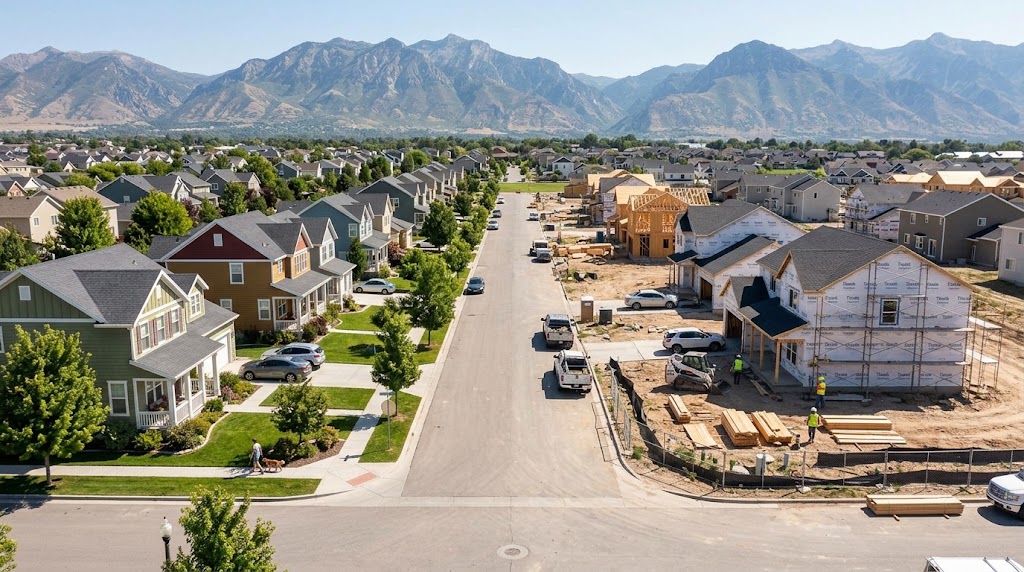
Is the new build in Daybreak really the better deal, or are you comparing a base price to a finished home?
When buyers weigh Daybreak resale vs. new construction, they usually set a builder’s advertised price, or a temporary payment, next to a resale’s asking price. Those numbers aren’t measuring the same thing. A fair comparison puts the same finished features, the same loan assumptions, and the same monthly obligations on both sides. Once you do that, either home can come out ahead. The point is to find out which one fits your budget, timing, and plans, using real written numbers.
Compare the Delivered Home, Not the Starting Number
I break the full cost of each Daybreak home into five buckets so nothing gets counted twice or left out.
Who Represents You When You Walk Into a Daybreak Sales Center?
Settle this before you fall in love with a model home: the people in a builder’s sales center work for the builder. They can be helpful, knowledgeable, and kind, and still not be your independent adviser.
That isn’t a criticism. Builder marketing describes the builder’s product the way the builder wants it seen. My job on the buyer side is different: to put that product next to your other options, a resale included, and ask the questions that protect your budget.
The Utah Real Estate Purchase Contract includes an agency confirmation, a section that states who represents whom. It also has separate fields for payments and inclusions. A builder may use its own contract instead, so don’t assume the terms match the state form. Read whatever you’re actually asked to sign.
Before a first visit, I’d ask a few questions:
- Does this builder have a registration or first-visit policy for buyers who want their own agent?
- Will I sign a written agreement for representation, and how is compensation handled? Don’t assume it’s free or automatic.
- Whose contract will I sign, the builder’s or the state form, and what’s different about it?
If you’re not sure, reach out before the first visit. It’s much easier to set up representation before you walk in than to sort it out afterward.
Base Price vs. the Real Delivered Cost
A new-construction price can mean very different things depending on what you’re actually buying. Before you compare, find out which of these the builder is offering:
Build-to-order
You choose the lot, plan, and options. The advertised price is a starting point, and the final number depends on your selections.
Under construction
Some choices are already made. Ask exactly which ones, and what’s still open.
Quick move-in
A completed or nearly completed home. Read the written spec to see what’s actually installed.
Model
Often shows upgrades. Find out which features come with the price you’re quoted and which are display only.
For a new home, ask for the written specification and allowances, the lot premium, structural and design options, and a clear list of what’s excluded. I want every inclusion in writing. The model’s finishes aren’t a promise.
For a resale, the work runs the other way. Confirm what transfers in the signed contract, not what appears in the listing photos. Then match useful features instead of comparing total square footage alone. Compare finished living area, parking, outdoor space, condition, and what’s included.
Some features may be missing from the new home’s quote and already in place at the resale, or the reverse: window coverings, appliances, fencing, landscaping, a finished basement. List each one with an estimated cost from a real quote or estimate, and keep that list separate from the purchase price.
The Five Cost Buckets I Use for Every Daybreak Comparison
This is the core of the method. Put both homes through the same five buckets, using the same loan scenario and the same expected years of ownership.
A few rules keep the math honest:
- Don’t count a deposit twice. If an earnest money or builder deposit is credited at closing, subtract it once.
- A closing credit isn’t a price cut unless the written deal actually lowers the price. Keep credits in the closing-cash bucket.
- Use an incentive once. If it lowers your rate, it belongs in the loan comparison, not also in the price.
- Keep principal separate from borrowing cost. Paying down your own loan isn’t the same as paying interest and fees.
| Bucket | New Construction: Ask For | Resale: Ask For |
|---|---|---|
| Delivered price | Written spec, lot premium, options, and exclusions | Signed contract inclusions and what actually transfers |
| Closing cash | Deposit schedule, credits, and association charges at closing | Earnest money, credits, and association charges at closing |
| Monthly budget | Payment after any temporary rate ends, plus the tax basis once the home is finished | Current tax record, insurance quote, and every association charge |
| Move-in work | Coverings, appliances, landscaping, and fencing not included | Repairs and updates from the inspection |
| Timing and risk | Completion terms, change-order rules, and the written warranty | Condition findings, systems’ age, and your possession date |
Taxes and insurance on a home that isn’t finished yet
The monthly budget bucket is where new construction is easiest to underestimate. A home still under construction may have a tax record that doesn’t reflect the finished house yet. Ask what the tax figure in your estimate is based on, and whether it will change once the home is complete. Your lender and the county records can help you get closer, but treat the early number as provisional.
Insurance needs the same care. Get a real quote for each address, and ask your agent how any association coverage affects what you need to carry. For a resale, you can usually start from the current tax record and an actual insurance quote, which makes that side of the comparison steadier. The new build isn’t more expensive because of this. You’re just working with less settled numbers, so build in a margin until they’re confirmed.
Daybreak Association Charges: Base Dues Are Only the Start
Daybreak has a layered association structure, and this is where full-cost comparisons often go wrong.
The developer’s community association overview states a 2026 base assessment of $144.50 per month. That’s the published base, not necessarily the full bill for a specific home.
The association’s Realtors and New Owners page explains that some properties also belong to sub-associations or Benefited Service Areas (BSAs), which can provide additional services. So two Daybreak homes, even two that look alike, can carry different total charges.
Here’s how I’d handle it for both homes:
- Build one ledger per address with every charge: master, sub-association, and BSA.
- Check whether a quoted amount already includes the master dues, so you don’t add it twice.
- Ask what each layer actually provides. Don’t assume a BSA is a separate HOA without checking.
- Ask about one-time charges due at closing, and get a written quote rather than estimating a percentage.
The same page says Daybreak directs Realtors to HomeWiseDocs for closing documents. For a resale, I’d request the property’s current closing package that way, through the transaction, instead of relying on a marketing summary. For a new home, ask the builder for the same address-level breakdown in writing.
What Does an Incentive Really Change After You Compare the Loan Terms?
Builder incentives can be real and valuable. They can also make two homes look closer in cost than they are, or further apart. The way to check is to compare full loan terms, not headline numbers.
The Consumer Financial Protection Bureau’s guide to comparing Loan Estimates recommends looking at the loan amount, rate, monthly payment, upfront charges, lender credits, and cash to close side by side. It also explains the five-year borrowing cost on the Loan Estimate: the total you’d pay over five years minus the principal you’d pay down. That’s interest and fees for that period, not your total cost of owning the home and not a prediction of equity.
When I look at any incentive, these are the questions I’d want answered in writing:
- Does this specific home qualify, and by what deadline must I sign and close?
- Is it a lower rate, a temporary payment reduction, or a credit toward closing costs?
- If the rate starts low, what does the payment become later, and when?
- What are the APR, the points, and the rate-lock period, and what does an extension cost?
- Is it tied to a particular lender or title company, and can it be combined with other offers?
- When can a credit actually be used, and is any of it lost if it isn’t needed?
Then get Loan Estimates for both homes with the same down payment, loan type, and timing. The CFPB’s Loan Estimate explainer notes that the tax and insurance figures on a Loan Estimate aren’t prices the lender controls. If one estimate looks much lower, find out why before calling it cheaper.
My rule on incentives: builder incentives vary by builder, home, and time, and they change. I won’t assume a promotion applies to the home you’re looking at until it’s confirmed in writing for that address and for you as the borrower.
Contract, Deposit, and Deadline Questions to Ask
New-construction contracts and resale contracts can handle risk very differently. Read the actual document you’d sign and get answers to these:
Deposits
How much is due, when, and under what conditions is it refundable? Is it credited at closing?
Financing and appraisal
What happens if the loan or appraisal doesn’t come through? Is there a condition that protects you?
Changes and options
What can you change after signing, by when, and at what cost?
Completion and delays
What does the contract say about completion, and what remedies apply if it slips?
Closing and possession
Can the stated dates actually work with your move, lease end, or current home sale?
A “ready” date on a builder website describes the builder’s expectations. It isn’t a delivery guarantee. If your move depends on a specific date, plan for overlapping housing costs in bucket four and read what the contract says about delays.
Questions about refunds, cancellation rights, and remedies are legal questions. I’ll help you find the provisions and flag what to ask. Interpreting them is for a real estate attorney.
Inspection and Walkthrough Checkpoints, and What the Warranty Covers
New doesn’t mean you can skip the inspection. And a builder warranty isn’t the same thing as an inspection.
The FTC’s guide to warranties for new homes describes builder warranties as limited coverage, with different periods for different components and specific exclusions. It also notes that a service contract is a different product. So read the actual warranty: what’s covered, for how long, what’s excluded, and how you make a claim in writing.
For new construction, I’d ask:
- Will my own inspector be allowed in, and at which stages of construction?
- How does the final walkthrough work, and how is the punch list recorded and finished?
- Who do I contact for warranty items after closing, and what’s the written process?
For a resale, your inspection is the main way to price the move-in work. Get qualified repair estimates for anything significant, and put them in bucket four rather than leaving them as a vague worry.
Either way, keep copies of the inspection reports, walkthrough notes, and warranty. They matter long after closing.
Village and Amenity Fit: Check the Rights, Not the Rendering
Daybreak isn’t one uniform neighborhood, and amenity access isn’t the same for every home. That matters for both resale and new construction.
The Dawn example is the reason I check amenity rights for every address. If one home has access to something the other doesn’t, that belongs in your comparison. Don’t assume it from the neighborhood name or a site map.
Being near a feature isn’t the same as having access to it, either. Being in the Lower Villages doesn’t make a home lakefront, and a short drive doesn’t make it walkable. Go see the home and check the documents.
If your new-construction option is in an area still being built, visit at different times so you see what daily life looks like right now. Note what you observe and the date. Don’t count on surrounding work being finished by a certain time unless that’s in writing.
Where this guidance comes from: association figures and structure come from Daybreak’s community association overview and its Realtors and New Owners page. Village and amenity locations come from the developer’s amenities page. The amenity exclusion comes from David Weekley’s The Dawn at Daybreak page. Loan and warranty guidance comes from the CFPB and FTC, and contract mechanics come from the Utah Real Estate Purchase Contract. Builder pages describe the builder’s offering. The buyer-side comparison here is mine. None of it replaces your signed contract, written quotes, or professional advice.
When I’d Give a Daybreak Resale the Same Side-by-Side Review
I don’t start with a winner. But there are situations where I’d make sure a resale gets a full, fair comparison against a new build:
- Your move date is firm. A resale with a known possession date can reduce the timing risk in bucket five.
- The new home’s quote is missing a lot. Once landscaping, fencing, coverings, and appliances are priced, the gap may shrink or flip.
- You want a specific village or setting. The home you want may only be available as a resale where you want to live.
- You’d rather see the finished home. A resale lets you inspect exactly what you’re buying.
The reverse is true too. A new build can win once the resale’s repairs and updates are priced honestly, or when the written incentive makes the long-term payment a better fit. Run the numbers both ways.
Two questions I’d ask before deciding:
- Would the resale still fit better once repairs and missing features are priced, or would the new build?
- What do the inspection, punch list, and warranty leave unresolved for each home?
What to Gather Before I Compare Them
You don’t need everything to start, but the more of this you have, the more useful a side-by-side review will be:
From the builder
The itemized quote, written spec, lot and option charges, the contract you’d sign, and the warranty document.
From the resale
The listing, seller disclosures, the inspection report if you have one, and what the contract says is included.
From your lender
Loan Estimates for both homes with the same down payment, loan type, and timing.
From you
Your move date, how long you plan to stay, and the three features you won’t give up.
If some of it is missing, that’s fine. A missing number is something to note on the comparison, and often it’s the first thing I’d help you track down.
A Note for Daybreak Resale Sellers
If you’re selling a Daybreak resale, buyers are likely comparing your home against builder quotes. Make the comparison easy:
- List what’s included that a base new-construction price may not cover, like coverings, appliances, landscaping, and fencing, and make sure the contract reflects it.
- Have your association information ready, including any sub-association or BSA charges, so buyers aren’t guessing.
- Gather receipts, permits, and warranties for any improvements.
- Be ready to talk about possession timing. A known date can matter a lot to a buyer with a fixed move.
For the bigger picture, see my Daybreak real estate and housing guide and the Daybreak community page for what living in Daybreak looks like day to day.
Frequently Asked Questions
Is a builder’s base price what I’ll pay for the finished home?
Usually not. Lot premiums, structural and design options, and items not included can change the delivered price. Ask for the written spec and every charge, then compare the result with a resale’s signed-contract inclusions.
Do all Daybreak homes pay the same total HOA amount?
No. Daybreak publishes a 2026 base assessment of $144.50 per month, but some properties also belong to sub-associations or Benefited Service Areas with additional charges. Get the full schedule for each specific address.
Is a builder’s starting payment rate the same as a fixed mortgage rate?
Not necessarily. Some incentives lower the payment temporarily or for an initial period. Compare Loan Estimates for both homes using the same assumptions, and ask what the payment will be after any introductory period ends.
Does a builder warranty replace an inspection?
No. The FTC describes new-home warranties as limited, with component-specific periods and exclusions. Ask whether your own inspector can access the home, and read the warranty and claim process in writing.
Who pays transfer or other association charges at closing?
It depends on the contract and the association’s current fee schedule. Get a written quote for the specific property and confirm in the contract who pays each charge, rather than assuming.
Should I talk with you before visiting a model home?
It’s a good idea. Builders may have registration or first-visit policies, and the sales team represents the builder. Sorting out representation first keeps your options open.
Comparing a Daybreak Resale With a Builder Quote?
Send me the two Daybreak homes, the written quotes, or the priorities you’re weighing, and I’ll give you a practical side-by-side read using the same five buckets. If you’d rather talk first, call me before you commit.