Are South Jordan’s 2026 growth priorities a reason to favor one home over another? The honest answer is that they are useful signals, not forecasts. In South Jordan, a city priority can tell you where leaders are directing attention, but it does not prove that a project is funded, under construction, or ready to improve your daily routine.
Here is what I would do before future development influences your offer: separate what exists now from what is proposed, planned, conditional, or still uncertain. Then test the listing as though every future convenience arrives later than expected. If the home still works, growth can become context instead of a promise you are paying for.
What South Jordan Future Development Should Mean to You
Use growth information to sharpen your questions about routes, services, activity, housing type, and construction exposure. Do not use it to predict appreciation or assume that a planned feature will arrive on your timeline.
Why Is Future Development Part of a Home Decision but Not a Forecast?
Future development matters because a home is not isolated from the streets, services, housing, employment, recreation, and commercial activity around it. A new civic facility can change the kind of trips people make nearby. Additional housing can change the mix of homes and daily activity. A mixed-use district can create more reasons to visit an area. None of that automatically tells you whether a particular address is right for your week.
The mistake I see buyers make is treating one announcement as a complete neighborhood answer. A project headline can sound specific while the details underneath it remain conditional. A priority may not yet have final funding. A proposed project may still change in scope. A first-party development date may be a target rather than a guarantee. A citywide job count may say nothing about the route between your driveway and your workplace.
Real talk: the more future-facing the claim, the more carefully you should label it. “The city identified this as a 2026 priority” is a useful fact. “This will be finished soon and make the area more convenient” is a prediction. Those two statements are not interchangeable, and your offer should not treat them as though they are.
I use a five-level status check. It keeps a planning conversation calm because you are not arguing about whether growth is good or bad. You are asking what the record actually supports today.
This status ladder also protects you from paying emotionally for a feature that may not be usable from the home. A planned entertainment use several miles away may have little effect on your routine. An existing grocery, clinic, park, or transit stop on the route you already drive may matter much more. The address decides the practical value.
What this means for you is straightforward: let today’s routine carry the decision. Let future South Jordan development become a qualified bonus, a possible tradeoff, or a reason for more due diligence. Do not make it the foundation unless the current facts are strong enough to support that weight.
What Do South Jordan’s 2026 Priorities Actually Signal?
South Jordan City published its 2026 State of the City priorities on January 12, 2026. The list included a 17,000-square-foot senior center paired with affordable senior housing, continued economic growth intended to bring jobs, restaurants, and entertainment, and a plan for a professional pickleball facility. That tells you which themes the city chose to emphasize in 2026: senior services and housing, economic activity, and recreation.
It does not tell you that each item has the same status. The senior center has a separate official project page and is described there as proposed. The pickleball facility appears in the priority announcement as a plan. The economic-growth language describes direction but does not identify a guaranteed tenant list or a fixed number of future jobs. The words around the item matter.
The city’s Economic Development page adds current scale. As of July 2026, South Jordan reported nearly 2,000 active business licenses, including home occupations, and more than 27,000 jobs. Those figures can help you understand that South Jordan has a substantial employment and business base. They cannot tell you that the job you want, the service you need, or the restaurant you will use sits near the listing.
Here is how I translate a citywide number into a home question: where is your actual destination, and what route connects it to this address? If your workplace is outside South Jordan, the citywide job count may have little effect on your commute. If your weekly health-care, shopping, or recreation stops are on the other side of the city, a broad growth statistic may not reduce the friction in your day.
The same rule applies to senior services. A proposed senior center can be relevant to a downsizing household, an adult child helping a parent, or a buyer who values civic programming. But relevance depends on final project status, route, access, and the services ultimately offered. The priority gives you a reason to investigate. It does not give you permission to assume.
Source basis: The verified growth facts here come from South Jordan City’s dated 2026 State of the City priorities, its current Economic Development page, and the official Senior Center Project page. I use those sources to identify status and scale. They do not establish the effect on a specific home.
What Exists Now in Downtown Daybreak and The District?
Buyers sometimes group all western South Jordan development into one idea. I would not. The District and Downtown Daybreak are separate mixed-use anchors, and they can affect a home search in different ways. They have different routes, different surrounding housing patterns, and different kinds of activity.
South Jordan City identifies The District as one of its largest mixed-use developments. That makes it an existing point of reference for errands, dining, entertainment, and the proposed Senior Center Project. If you are considering a home near The District, the useful test is not whether the city calls it mixed-use. The useful test is whether the entrance you use, the parking pattern, the direction of your normal trips, and the time you visit make the district practical for you.
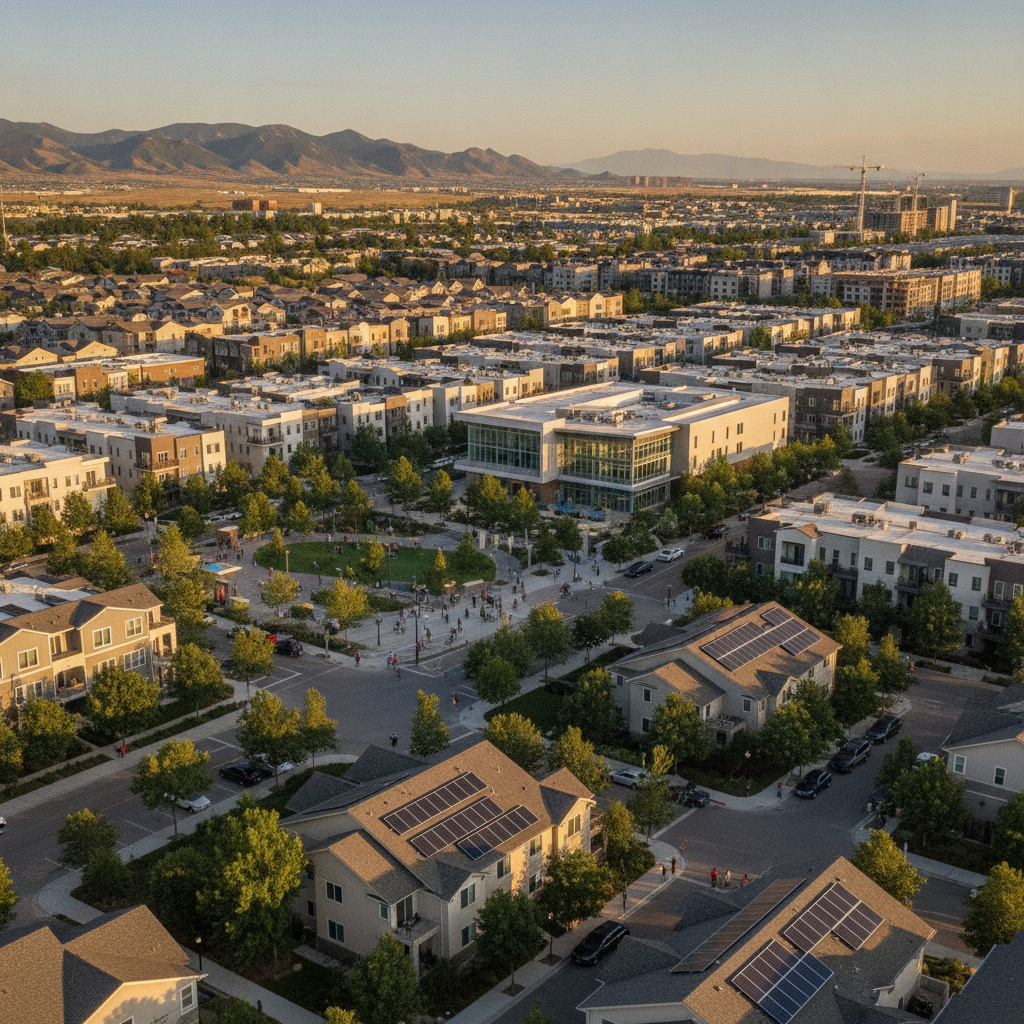
South Jordan City describes Downtown Daybreak as an urban center with ballpark, cinema-entertainment, housing, transit, and other mixed-use activity. That description establishes a district type. It does not mean every component is complete, every home in Daybreak is close to it, or every buyer will value the same level of activity.
A buyer who wants frequent events, dining, or a more active district may like being closer. Another buyer may prefer to visit when desired and return to a pocket with less event-related activity. Neither preference is more correct. The right answer depends on how often you will use the district and how much separation you want on ordinary days.
I also separate a named district from a named project inside the district. One existing asset does not prove that every planned residential, entertainment, or transit feature is ready. One future building does not describe the entire district. Break the broad label into individual pieces and give each one a status.
| Local anchor or signal | Verified status | What the listing still needs to prove |
|---|---|---|
| The District | Existing mixed-use anchor identified by South Jordan City. | Whether your normal errands, entrances, parking, and return route make it useful from the exact address. |
| Downtown Daybreak | City-described mixed-use urban-center context with existing and evolving components. | Which destinations exist now, how you reach them, and whether activity is a benefit or a tradeoff for your household. |
| Senior Center Project | Officially described as a proposed 17,000-square-foot center at The District, paired with proposed senior housing. | Final approval, scope, access, timing, and whether the project matters to your routine at all. |
| 2026 economic priority | Stated city direction involving jobs, restaurants, and entertainment. | Which businesses or services are actually open near the home today; no future tenant list is guaranteed. |
| Pickleball facility plan | Named in the 2026 priority announcement as a plan. | Current site, status, access, schedule, and relevance before you let it influence the home choice. |
The table is intentionally categorical. I am not assigning value, traffic, or appreciation to any item. I am showing you what kind of claim you are dealing with. That is the clarity you need before you compare pockets.
During a tour, look beyond the destination. Notice the streets between the home and the district. Check how you enter the neighborhood, whether an event changes your preferred route, where residential and commercial uses meet, and whether the home’s parking or guest pattern fits the surrounding activity. Those observations are more useful than a broad promise that a home is “near development.”
How Could Jobs, Services, Routes, and Housing Type Affect Your Routine?
South Jordan growth can influence more than retail. A city priority that pairs senior services with housing raises questions about civic access, housing type, and the activity around a mixed-use center. Economic-development priorities raise questions about jobs and services. Entertainment plans raise questions about evening and weekend trips. Your job is to decide which of those categories matters to the way you actually live.
The proposed Senior Center Project page describes a 17,000-square-foot center at The District and approximately 200 senior-housing units, with at least 75 percent intended to follow affordable-housing guidelines. Those are proposed-project details as of the source date. They are not final eligibility rules, guaranteed unit counts, or a completion promise.
For a buyer, the proposal can prompt several useful questions. Would you value being near senior programming or services? Would a mixed civic and residential use change how often you visit The District? Does the home type you are considering already meet your long-term needs, or are you using a future project to compensate for a home that does not?
Housing type matters because “growth” is not one product. A district may include apartments, townhomes, senior housing, or other residential forms alongside commercial and civic uses. That can create more choices, but it can also change parking, construction exposure, guest patterns, and the feel of nearby streets. You should verify the exact property and the current surrounding uses rather than making a broad assumption from a district name.
Jobs need the same discipline. The city’s July 2026 figures describe South Jordan as a whole. Your daily drive depends on your workplace, your start time, your school or childcare stops, and the road you use. A new job somewhere in the city does not automatically shorten your commute. A service added across town may not simplify your errands. Always bring the citywide claim back to the address.
Run the “no future project” routine
Before you count any future benefit, drive the listing’s current routine. Go to the grocery store you expect to use. Drive to work or the transit connection at the relevant time. Add school, childcare, a medical appointment, fitness, and the evening stop you repeat most often. Then ask whether the home still feels workable without the proposed senior center, additional restaurants, a new entertainment use, or any other announced feature.
This test is intentionally conservative. It keeps you from betting your normal week on a timeline you do not control. It also helps you recognize when an existing asset already does more for you than a future project would.
Test ordinary and active periods
If Downtown Daybreak, America First Square, The District, or another activity center matters to your decision, visit during an ordinary period and during a busier event or evening period. I am not asking you to label the area busy or quiet. I am asking you to observe the conditions you care about: parking, turns, light, pedestrian activity, the route home, and how much activity you want near your address.
The same location can feel useful to one household and distracting to another. That is why I will not reduce the question to “close is better.” Close only matters when the destination is something you will use and the surrounding pattern fits your tolerance.
Look at the home, not only the district
A home near future development still has to pass the normal property test. Does the layout work? Is parking adequate for your household? Does the yard or maintenance level fit? Are there association rules or shared responsibilities to review? Does the home sit beside a vacant parcel, active construction, a district edge, or a route that could change how the street feels?
Future development can become a distraction when the house itself misses your needs. The home is the part you are buying. The district is context. Keep them in that order.
How Do You Separate Current Reality From Future Promise?
I would use the same six-step check for every South Jordan development claim, whether it comes from a city announcement, a project page, a builder, a listing, or a conversation during a tour.
Name the exact feature
Do not research “South Jordan growth” as one idea. Write down the specific senior center, housing project, road, district component, service, restaurant, recreation use, or transit feature that matters to you.
Find the controlling source
Use the official city project page or the first-party district source. A listing can point you toward a claim, but it should not control the status.
Record the source date
A 2026 priority, a 2025 opening, and a future leasing target describe different moments. Save the page or note the access date so you know what the statement meant when you relied on it.
Assign one status
Mark the item as existing, under construction, formally proposed or approved, a stated priority or plan, or possible and uncertain. Do not blend categories because the marketing language sounds confident.
Test the current routine
Drive the routes you will use and decide whether the address works if the project is delayed, reduced, relocated, or never becomes part of your week.
Decide how much weight it earns
Existing daily convenience can carry meaningful weight. A proposed feature may deserve a note. An uncertain idea should not be priced into your personal decision as though it is already available.
This process also helps sellers. If a nearby project is part of the listing story, describe the status accurately and point buyers to the controlling source. Do not promise timing, tenants, traffic effects, or value. Clear qualification builds more trust than a polished prediction.
For buyers, keep a simple evidence file. Save the official page, a screenshot or note of the date, photos from the surrounding streets, and your route observations. If the project is important enough to influence your offer, it is important enough to document.
What Should You Verify Before Choosing a South Jordan Pocket?
Bring the pocket into focus before you bring the future into the offer. I would answer these questions in writing for each listing you are seriously considering:
- What exists today? Name the stores, services, parks, transit, employment, and civic facilities you can use now.
- What is only proposed or planned? Identify the exact source, date, and status for each future feature you care about.
- Does the home work if every future item is delayed? If the answer is no, the offer may be carrying too much project risk for your tolerance.
- Which route will you actually use? Test work, school, childcare, health care, groceries, dining, and recreation from the driveway.
- How much activity do you want nearby? Visit during ordinary and event-active periods without assuming activity is automatically positive or negative.
- What housing or construction is beside the home? Check current uses, vacant parcels, proposed buildings, phase boundaries, and access points.
- Which claim needs confirmation before the offer? Decide whether you need the city, developer, association, district, or another official source.
- What is your walk-away condition? Be clear about the timeline, construction exposure, route, or uncertainty that would make the pocket wrong for you.
The strongest South Jordan real estate decision is not the one with the most exciting growth story. It is the one where the current home and current routine already fit, and future development has been given only the weight its verified status deserves.
That is the whole point of this buyer lens. Growth can change a city. It can also create noise in a home search. Your move gets clearer when you separate the two.
Frequently Asked Questions About South Jordan Future Development
Are South Jordan’s 2026 growth priorities guaranteed projects?
No. A priority shows a stated city direction for 2026. The status of each item must be checked separately. Some may have official project pages, while others remain plans or broader economic-development goals.
What is proposed for the South Jordan Senior Center Project?
The official project page describes a proposed 17,000-square-foot senior center at The District, paired with approximately 200 senior-housing units and an intended affordability component. Keep every detail qualified because approval, scope, eligibility, and timing can change.
Does the city’s job count mean a specific home has an easier commute?
No. The nearly 2,000 active business licenses and more than 27,000 jobs reported as of July 2026 are citywide scale figures. Your commute depends on the exact workplace, route, time, and other stops in your day.
Should I buy near Downtown Daybreak for future convenience?
Start by testing what exists and what you will use now. Then decide whether future district activity is a qualified bonus or a tradeoff. Do not rely on an unverified opening, tenant, or construction date.
How can I tell whether a development claim is reliable?
Find the controlling official or first-party source, save the date, identify the exact wording, and assign a status. “Proposed,” “planned,” “approved,” “under construction,” and “open” should never be treated as synonyms.
Can future development predict appreciation or resale value?
This article does not make that claim. A project announcement alone cannot establish appreciation, demand, resale performance, or investment return. Keep the decision tied to the current home, current market evidence, and your routine.
Want a South Jordan Future-Development Reality Check?
Send me the South Jordan pocket or listing you are considering. I will help you separate what exists now, what is formally proposed or planned, and what could affect your daily routine before future convenience becomes part of your offer.
Want to check what is real today before you bet on what may come next?