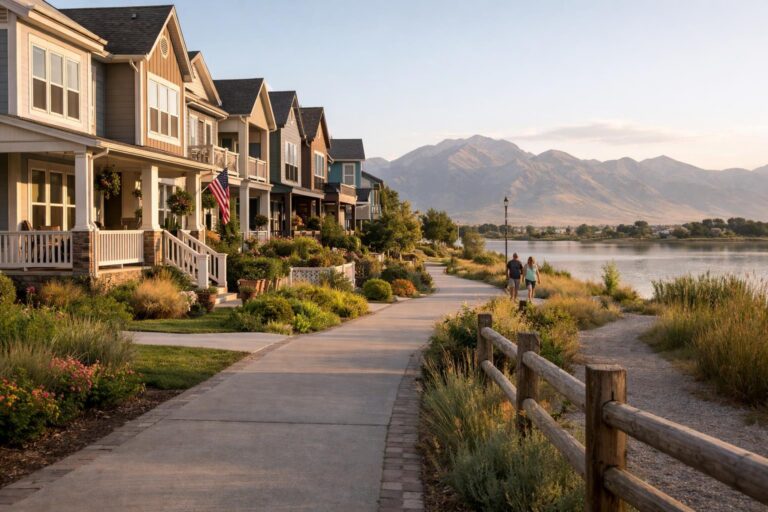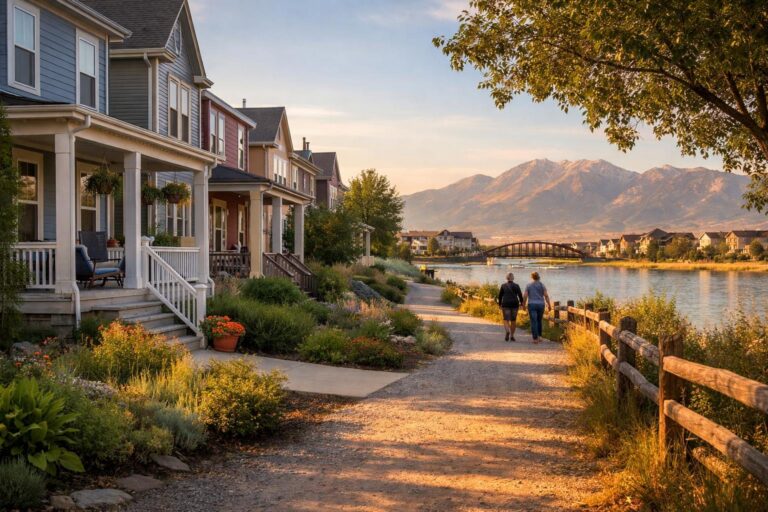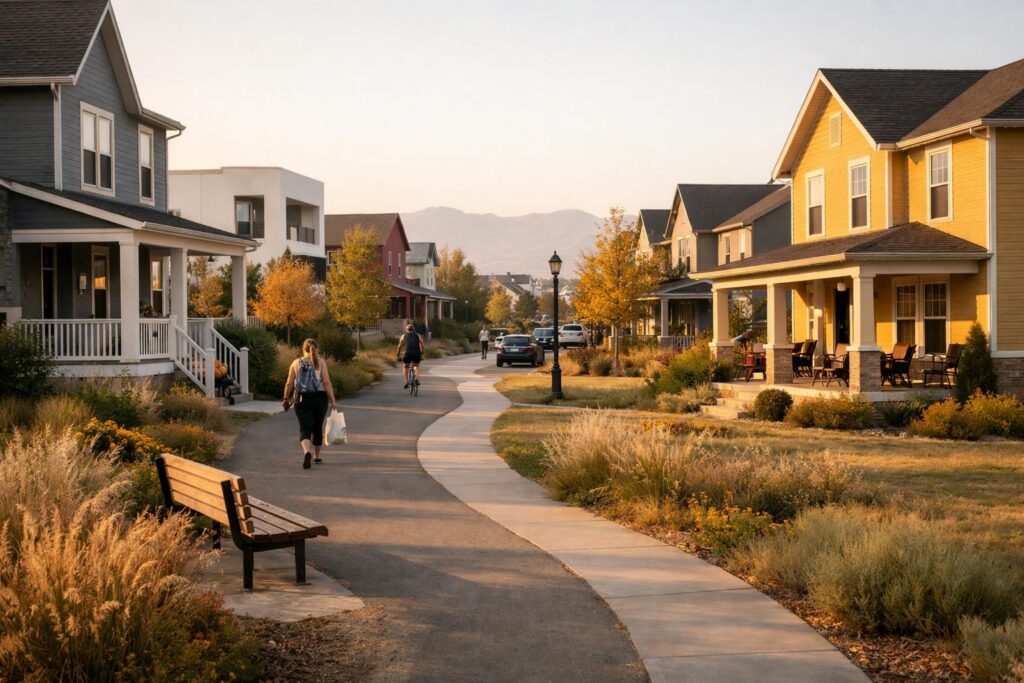
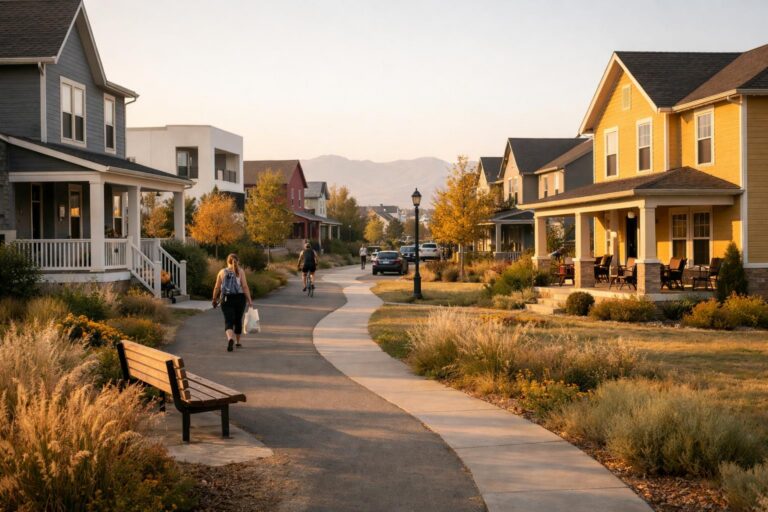
What is the practical difference between Daybreak’s Upper and Lower Villages? The Lower Villages are the community’s original, more established areas centered around Oquirrh Lake. The Upper Villages are newer areas organized around the Watercourse, The Loop, newer village plans, and more active development. Neither label tells you which home fits.
I use the village map as an orientation, then I compare the exact home, association, route, construction context, parking, trail or water access, and places you will actually use. Downtown Daybreak also deserves its own column; it does not fit neatly into a two-part slogan.
Development Era and Amenity Anchor Shape the Difference
These four ideas keep the comparison grounded.
What Upper and Lower Villages Mean—and What They Do Not
Daybreak’s official villages page describes the Lower Villages as the place where the community began, with gracefully maturing neighborhoods centered around Oquirrh Lake. That makes the label useful for understanding development era and physical orientation. It does not mean every lower-village home is old, identical, or free from nearby change.
The same official source describes the Upper Villages as newer areas shaped around the Watercourse, The Loop, parks, bicycle routes, and newer home designs. Cascade Village and Watermark Village are named Upper Villages. Again, the label is a starting point. It does not confirm the current availability, completion, association details, or walking route for a home.
The Island is identified in the Lower Villages, surrounded by Oquirrh Lake. That is a specific residential context, not a summary of all lower-village life. Other lower villages have different street patterns, home types, distances, and association questions.
Buyers sometimes hear “upper” and assume higher quality or “lower” and assume older means less current. I would remove both judgments. The practical distinctions are maturity, visible street condition, construction phase, amenity anchor, home product, route, and how much future change remains around the address.
Daybreak also changes over time. A first-party community page is useful for names, intended features, and current orientation, but it is not independent proof of market value, demand, school quality, or investment performance. I use it for what it can verify and keep the rest out.
Source basis: Daybreak’s official Villages and Districts page distinguishes Upper Villages, Lower Villages, and Downtown Daybreak. Its amenities page identifies Oquirrh Lake, the Watercourse, and The Loop. Treat these as first-party community descriptions and verify current access, rules, and property-specific proximity.
How a Normal Weekday Changes by Address
Start with the first trip out of the neighborhood. A lower-village resale and an upper-village new home can use different local streets before meeting the same regional corridor. Drive both at the time you would normally leave. Notice construction, signals, turns, school-zone activity, and the path to the road you actually need.
Transit may matter. UTA’s Red Line serves South Jordan Parkway, South Jordan Downtown, and Daybreak Parkway. A Daybreak address is not automatically practical for rail. Test the route to the station, parking or walking plan, schedule, transfer, and return trip.
Errands create another pattern. SoDa Row, Downtown Daybreak, neighborhood retail, services elsewhere in South Jordan, and regional shopping may land differently from each home. Count the places you use repeatedly, not every business in the community description.
School routes must be verified for the exact address through the district’s current information. Do not assume a village name settles assignment, transportation, or future boundaries. If the route affects the purchase, test it and confirm it directly.
Parking and storage often decide more than distance. A townhome near a destination may have guest, driveway, garage, or street rules that change the routine. A detached home farther away may provide more private parking while adding yard work and a different route. Compare the whole obligation.
Finally, test the evening. Arrive after work, find guest parking, walk the entry, notice lighting and activity, and decide whether the surrounding spaces fit the household after the planned outing ends. Daily life is not a community brochure; it is the repeated arrival.
| Decision Area | Lower Villages Check | Upper Villages Check |
|---|---|---|
| Street context | Observe the mature street, landscaping, parking, current neighbors, and known route. | Verify the active phase, completed streets, nearby building, access changes, and route today. |
| Water anchor | Map the actual connection to Oquirrh Lake and verify current rules and access. | Map the actual connection to the Watercourse and verify completion, rules, and access. |
| Home evidence | Review resale condition, records, improvements, association documents, and inspection. | Review builder plan, specifications, inclusions, contract, inspections, walkthrough, and warranty. |
| Change | Check nearby parcels and Downtown activity even in established areas. | Check phase completion, future streets, amenities, construction, and promised features. |
| Routine | Test established routes to work, errands, rail, parks, and gathering places. | Test current—not future—routes to the same repeated destinations. |
Oquirrh Lake, the Watercourse, and the Trail Routine
Oquirrh Lake is the defining water anchor for the Lower Villages. The useful buyer question is not whether the lake exists. It is how the home connects to it. Which entrance would you use? Is the walking or biking path direct? What are the current rules, hours, and resident-access requirements? Does the household actually want the routine?
The Watercourse is the Upper Villages water anchor described by Daybreak’s official source. It is connected to parks and paths in the developing upper area. Verify which portions and facilities are open, the current use rules, and the route from the specific home. Do not buy a map promise as if every feature is complete.
The Loop is described as a network of trails, bicycle routes, and park spaces through the Upper Villages. That may appeal to a buyer who wants a connected outdoor route. Test the grade, crossings, lighting, weather exposure, and distance that matter to the person who will use it.
Lower-village paths around Oquirrh Lake can feel more established, with mature landscaping and a visible route. Mature does not mean maintenance-free or universally closer. A home deeper inside a village may have a different practical connection than a property on a map edge.
Amenity access can be governed by the Daybreak Community Association or another association. Ask which credentials, guest rules, seasonal closures, reservations, or fees apply. A listing statement is not the controlling source.
I also ask what happens when the water activity is not available. Does the trail, park, gathering space, or view still matter? A strong location decision should survive a seasonal change in programming.
Oquirrh Lake
Lower-village anchor; verify the exact path, resident rules, current access, and how often the household would use it.
The Watercourse
Upper-village anchor; verify completed facilities, current operating guidance, association rules, and address connection.
The Loop
Upper-village trail and bicycle network; test the usable route rather than relying on a community-wide description.
Neighborhood parks
Compare the nearest practical park, crossings, equipment, shade, reservations, and how it fits an ordinary week.
Where Downtown Daybreak Fits in the Orientation
Downtown Daybreak is not simply upper or lower. The official villages page presents it as an emerging center with dining, entertainment, events, light-rail access, and the ballpark area. That makes it a separate orientation point for buyers considering a more urban routine inside South Jordan.
A home near Downtown may appeal to someone who values walking to an event, restaurant, station, or service. Verify the actual path and current tenant or facility rather than relying on a future rendering. Walking distance is an address-level test involving crossings, sidewalks, lighting, and the route the person will use.
Event access can be a benefit and a source of activity. Visit during an event and on a normal evening if the home is serious. Notice traffic, parking controls, sound, lighting, and how residents enter or leave the area. Do not assume the event-day experience represents every day.
New urban development also brings construction and change. Ask which building, street, or public-space work is active, approved, or conceptual. Confirm through the responsible source. A buyer who likes change may find that energizing; another may prefer a more completed street. Neither preference is a value ranking.
Transit belongs in the full trip. UTA’s South Jordan Downtown station opened in 2025. Check current Red Line schedules and service alerts, then test the last mile. A station nearby can be useful only if the rest of the route works.
If you are comparing Downtown with a lower-village lake-oriented home or an upper-village Watercourse home, the home products may differ too. Keep location, property type, HOA, parking, delivered cost, and construction context visible so the destination does not swallow the housing decision.
How Home Type and HOA Documents Change the Village Choice
Daybreak offers attached and detached homes in different settings. A townhome, cottage, larger detached home, condominium, and new-build product do not share the same parking, yard, maintenance, insurance, association, or financing questions. Village preference should not replace property review.
Ask how many associations apply. There may be a community association plus a sub-association or property-specific structure. Review current dues, budgets, insurance, reserves where available, maintenance boundaries, amenity rights, rental rules, pet rules, parking, design controls, and pending assessments or projects supplied for the transaction.
In an established lower-village resale, association records and the current physical condition can provide history. Review meeting material, visible common-area condition, prior projects, and the seller’s documents. Do not assume an established association has no future work.
In an upper-village new home, ask how the association is funded during development, which amenities are complete, who maintains unfinished areas, when control may transition, and whether future phases change the budget or obligations. The contract and current association documents should answer the question, not a broad community statement.
Parking can vary sharply. Measure the garage, understand driveway rights, locate guest options, read street and association rules, and visit after work. A walkable location can still fail if the vehicles and guests have no practical plan.
Outdoor space deserves the same precision. A small private yard, patio, porch, shared green, lake route, Watercourse connection, or nearby park can all support different routines. Ask what is private, common, maintained, reservable, restricted, or still planned.
How Much Construction and Future Change Fits You?
Upper-village buyers may face more active development around them, but lower-village and Downtown buyers should also check nearby change. Start with what you can see, then verify it. Construction signs, model centers, unfinished streets, vacant parcels, or temporary access raise questions; they do not provide the schedule.
Ask for current phase maps and written builder information for the home. Compare those with city planning or project sources where the issue overlaps public approvals. Identify which roads, parks, water features, retail spaces, schools, or facilities are complete and which are proposed.
Decide what kind of change affects you. Noise during working hours may matter to someone who works from home. Temporary route changes may matter to a household with tight school schedules. A future park may be appealing, but it should not carry the full value of a completed amenity.
Look at the home site. Nearby grading, drainage paths, retaining, lot completion, dust, equipment routes, and unfinished landscaping can shape the first years. Ask the inspector and builder about property-specific issues within their scope.
Understand the contract response to timing. If the home completion moves, how does that affect housing, financing, rate lock, moving, and possession? If a surrounding amenity or project is delayed, what does the agreement actually promise? Do not assume a sales rendering creates a remedy.
Resale buyers should ask how prior construction affected the home and what development remains nearby. An established home may provide clearer street evidence, but a growing community can still change around it.
Mark what is complete
Walk or drive the current streets, parks, paths, stations, retail, and water access you intend to use.
List what is promised
Find the current written source, responsible party, approval status, and whether a date is stated.
Measure the effect of delay
Decide what changes if a home, road, amenity, or business arrives later—or not as pictured.
Inspect the site context
Review grading, drainage, access, construction routes, dust, sound, lighting, and the current edge of development.
Accept only manageable unknowns
A purchase does not require perfect certainty. It requires honesty about the uncertainty you are choosing.
Build a One-Week Daybreak Reality Check
Give each serious address the same imagined week. Start with the morning departure, school or childcare connection, work route, package delivery, dog walk, groceries, evening activity, guest arrival, and weekend recreation. The village label matters only when it changes one of those real steps.
Walk from the home to the amenity you expect to use. Time the route, note crossings, construction, grade, lighting, and weather exposure, and confirm current access rules. Oquirrh Lake, the Watercourse, neighborhood parks, trails, and community facilities provide different experiences; none should be counted as equally convenient from every address.
If TRAX is part of the plan, test the complete station trip at the relevant hour. Include the walk, bicycle route, drive or parking, platform wait, transfers, destination walk, and late return. A home can be in Daybreak without producing the transit routine a buyer expects.
Now add ownership. Where do vehicles, bicycles, sports gear, strollers, seasonal items, and trash go? Which HOA handles the property? What does it maintain? Which amenities are included? What rules affect pets, parking, rentals, exterior changes, and common spaces? Read the current documents for the exact home.
Finish with the least convenient day: construction near the route, bad weather, a full guest-parking area, a delayed train, or an errand in the opposite direction. The better pocket is not the one with the most attractive description. It is the one whose ordinary benefits still outweigh its inconvenient moments.
Write the comparison immediately after each visit and separate observed facts, personal preferences, unanswered questions, and future assumptions. Then assign every unanswered item to the current document or responsible source that can verify it.
My Upper-versus-Lower Village Fit Test
Pick one real upper-village home and one real lower-village home in the budget. If Downtown is a serious option, give it a third column rather than forcing it into one side. Keep property type and condition visible so the location comparison stays fair.
Drive the repeated routes at realistic times. Include work, family, school verification, groceries, and the activity that drives the calendar. If TRAX matters, test the full trip. Record local turns and the last mile, not only mileage.
Walk the amenity connection you expect to use. For the lower home, that may be Oquirrh Lake, a park, SoDa Row, or another destination. For the upper home, it may be the Watercourse, The Loop, a park, or the Cove area. Verify resident access and current rules.
Compare the home obligation. List parking, storage, yard, shared walls, stairs, exterior work, delivered features, inspection evidence, and near-term maintenance. Review every association and any builder contract.
Visit once after work. Notice construction, event activity, parking, lighting, noise, and how the surrounding block feels when residents are home. A daytime tour and model visit do not answer that.
Write down one strength and one accepted unknown for each home. The lower home may offer a visible mature setting while carrying older-home maintenance. The upper home may offer a preferred plan while carrying more surrounding change. Use the actual properties, not the example.
My Daybreak community guide can help with the larger map. Send me the homes when you are ready to compare documents, route, and routine rather than village names.
Frequently Asked Questions
Are all new Daybreak homes in the Upper Villages?
No universal assumption is safe. Daybreak’s official source notes specific newer opportunities in different areas. Verify the exact village, builder, release, home status, and date.
What is the difference between Oquirrh Lake and the Watercourse?
Oquirrh Lake is the established water anchor of the Lower Villages. The Watercourse is the newer water feature associated with the Upper Villages. Verify current rules, access, and the route from the home.
Which villages are closest to TRAX?
Use UTA’s current station information and map the complete route from the exact address. A village label does not prove a useful walking, biking, driving, or schedule connection.
Do all Daybreak homes have the same HOA obligations?
No. Review the current documents for the property, including any sub-association, insurance, maintenance, rules, dues, reserves, amenity rights, and phase questions.
Are the Lower Villages always quieter or more established?
The official source describes them as the original, maturing part of Daybreak, but sound, traffic, events, construction, and street condition must be observed for the exact address. I do not make a universal quietness claim.
What should I send Jena for a village comparison?
Send the addresses, listing or builder documents, HOA material, your repeated routes, the amenities you will use, and the amount of nearby change you are comfortable accepting.
Which Daybreak Question Is Still Open?
Send me the Daybreak homes or routine question this guide raised. I will help you compare the village, home, association, route, and construction context without ranking one side.