
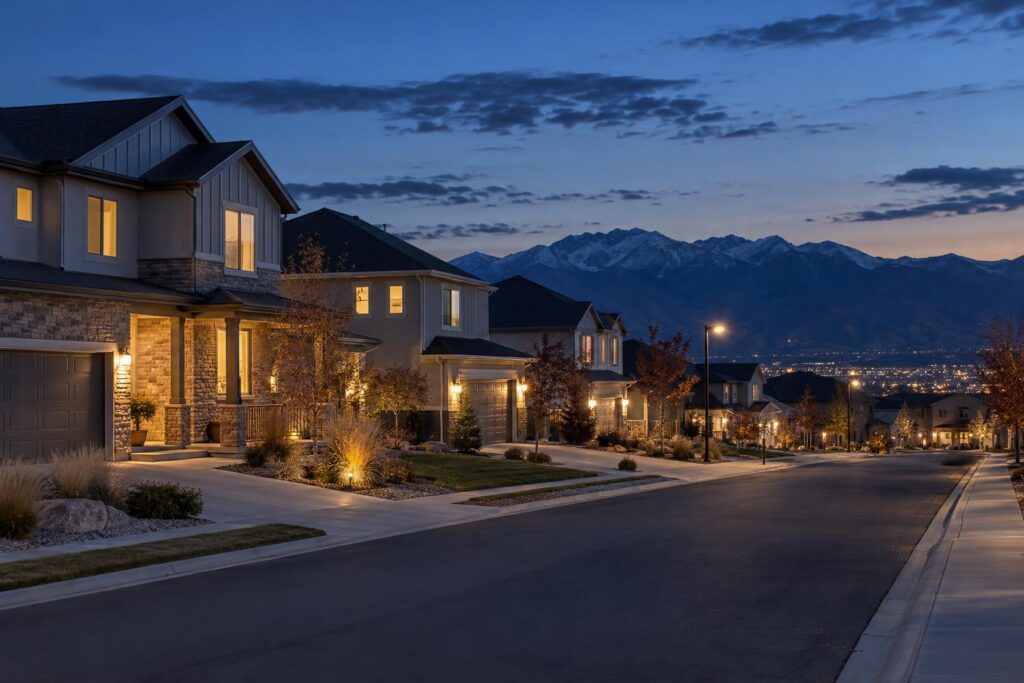
A Herriman home can make sense in a midday showing and leave you with different questions after dark. I would use a November evening visit to test the ordinary parts of your routine: arriving, parking, walking to the door, and using the rooms you expect to occupy at night.
This is an observation exercise, not a neighborhood safety assessment. One visit cannot establish crime risk, promise quiet, or tell you who lives nearby. It can show you practical details worth checking before you choose a home.
Allow roughly ten minutes for arrival and parking, ten for the public route you would actually use, and ten for notes or an authorized return showing. These are planning blocks, not measured driving or walking times.
Start with the arrival you expect to repeat
Daylight saving time ended November 1 in 2026, so a visit after work gives you a useful opportunity to see the property in darkness. Choose a time connected to your real schedule rather than a time selected only because it is convenient for a showing.
Begin from a relevant approach to the home. If your usual route would use Mountain View Corridor, test the approach you would actually take from there. Do not turn the drive into a promised commute time; traffic, weather, and your starting point can change the experience.
As you arrive, note the turn into the street, the visibility of the house number, and the place where you would stop or park. Can you identify the driveway without slowing abruptly? Is the entry obvious from the parking area? If something is unclear, write the question down rather than deciding it is a permanent problem after one pass.
Use lawful parking and respect private property. A second look at a house does not authorize entering a driveway, yard, garage, or shared private area. Arrange access with the listing side if an observation requires being on the property.
Look at parking as a task, not a photograph
Imagine unloading the things you normally bring home. The distance from your parking space to the door matters differently when you are carrying groceries, work equipment, or luggage. A layout that photographs well may still require a sequence of stairs or turns you want to experience yourself.
If a garage is part of the appeal, check its usable dimensions during an authorized showing. Then consider what changes when your storage is added. A garage described by vehicle capacity does not establish how your own car and belongings will fit together.
Observe nearby parking without assuming every open space is available to residents or visitors. Ask about restrictions that apply to the street or association. If winter parking is important to your plan, confirm the current snow-event rules separately; an empty curb on a dry evening does not settle that question.
I would record the practical issue in plain language: “Need to confirm guest parking,” or “Measure the turn from garage to kitchen.” Those notes lead to answers. A broad impression such as “parking seems difficult” is harder to investigate.
Walk the public route that matters to you
You do not need to tour every nearby street. Choose one route you would realistically use: from the home toward a public park, a regular pickup point, or another destination that belongs in your routine. Stay on lawful public routes and follow current signs.
Look for the details you could miss in daylight. Where are the crossings? Does the path continue where you expect? Is there a curb transition you need to inspect more closely? Are branches, parked vehicles, or temporary work affecting visibility during this visit?
Record lighting as an observation about a specific place and time. “The corner by this crossing was difficult for me to see at 6:30” is useful. It is not a basis for labeling the neighborhood safe or unsafe, and it does not establish what the lighting will be on another evening.
For a wider orientation before you choose the route, use my Herriman community overview. Then bring the decision back to one address. A park or destination being in Herriman does not establish a convenient route from every home in the city.
Use an evening showing to check the rooms differently
If you can arrange access, spend part of the visit inside. Stand in the room where you expect to work or relax in the evening. Note exterior light entering the windows, the view when interior lights are on, and any sound you can actually hear during that visit.
Do not turn a brief sound observation into a promise of permanent quiet. An evening without activity does not establish every night’s pattern. A louder moment may have a temporary explanation. When something matters to you, ask for context and consider another visit at a relevant time.
Check how the entry lighting operates and whether switches are where you expect. If an exterior light is not working, ask about it; do not assume the cause. If you want a different lighting arrangement, make it a property or association question rather than treating a future change as already approved.
Keep your own preferences visible. You may value a darker sleeping room, a direct garage entry, or fewer steps between parking and the kitchen. There is no need to turn those preferences into a claim that one street is objectively better than another.
| Observation | Compare with daylight | Follow-up |
|---|---|---|
| Arrival and house number | Was the entrance easier to identify earlier? | Confirm lighting or access questions |
| Parking to front door | What changes when carrying normal belongings? | Measure, check rules, or revisit |
| Public walking route | Are crossings and path transitions clear? | Check the exact route and current conditions |
| Room at night | How do light and sound differ during this visit? | Ask about a specific issue; avoid general conclusions |
Separate an ordinary evening from a special event
Herriman’s Night of Lights page lists the 2026 event for November 30 at City Hall and J. Lynn Crane Park/Crane Plaza. Check that page for the current event details before planning a visit nearby.
An event evening can be useful if you want to understand event-related activity, but label it that way in your notes. It should not stand in for an ordinary weekday. The reverse is true too: a quiet non-event visit does not tell you how the area operates during a scheduled gathering.
Weather is another variable to record. A dry November evening cannot tell you exactly how your route will look after snow. Herriman’s public-works maps provide a starting point for snowplow and sidewalk-removal questions. Use them to identify what needs confirmation, not to promise a clearing time.
How to make a second visit useful
Should I repeat the whole tour?
Repeat the part that could change your decision. If the concern is a crossing, revisit that route. If it is light entering a bedroom, arrange another authorized showing at a relevant time. A focused follow-up makes it easier to compare observations.
What should I write down immediately afterward?
Record the date, approximate time, weather, whether an event was occurring, the specific observation, and the question it creates. Keep preference separate from fact: “I prefer a shorter entry route” is your judgment; “this route includes these steps” is an observation to verify.
Share the important notes with your agent before the next showing. A question about parking rules needs a document or official answer, while a question about how a room feels may need another visit. Matching the follow-up to the question keeps the process useful and avoids repeatedly touring without resolving anything.
What people get wrong about touring after dark
“An evening visit tells me whether an area is safe.”
It does not. This visit is for observing access, lighting, parking, and the home’s fit with your routine. It is not a crime analysis or a basis for making assumptions about residents.
“One quiet visit means the street is always quiet.”
It tells you what you experienced at that time. Note the date, conditions, and any special event, and revisit a specific concern if it could change your purchase decision.
“The more streets I drive, the better the decision.”
A focused check of your actual arrival and walking route can be more useful than a long, unfocused drive. You want answers to your questions, not a vague ranking of neighborhoods.
After the visit, compare your notes with the daytime showing before memory smooths over the differences. Keep the observations you can describe, separate the questions you still need answered, and discard assumptions about people you happened to see.
If a move is becoming likely, my local moving checklist can help turn the practical findings into preparation. Your evening tour should make that preparation more specific.
Trying to picture the end of a workday in Herriman?
Send me the addresses you’re considering and the routine you want to test. I’ll suggest a focused evening route and the questions worth bringing to a return showing.