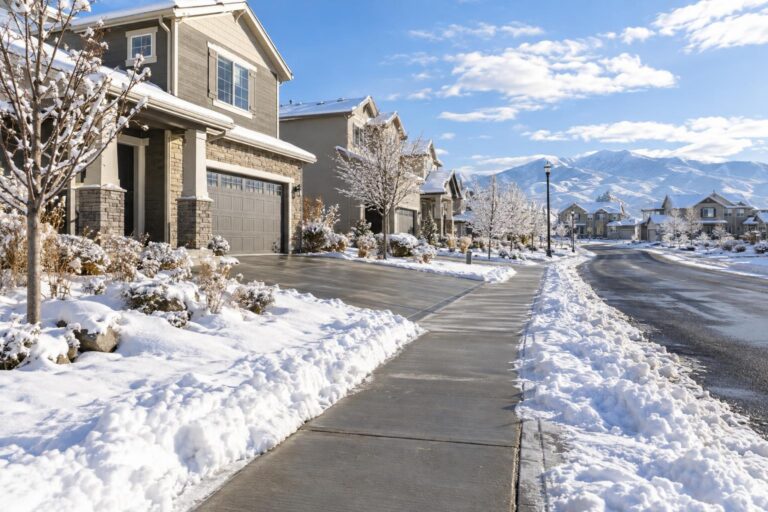
When you buy a Herriman home, winter maintenance starts with a simple division: public-road plowing is one job, and getting from that road to your door is another. Your driveway, adjacent sidewalk, and any private or association-managed areas need their own answers.
I would check those responsibilities while choosing the home, not during the first storm. The driveway shape, parking arrangement, and place to put cleared snow can affect your routine as much as the equipment you buy.
A plowed roadway does not mean a cleared driveway or sidewalk. An HOA fee does not establish that every winter task is included. Confirm who handles each surface at the specific property.
What the city says about public-road plowing
Herriman’s snow-removal guidance describes roadway plowing beginning at two inches of accumulation, with higher-priority roads handled before subdivisions and cul-de-sacs. It does not promise a completion time for your street.
That distinction matters when you are comparing addresses. A home on a lower-priority street should not be evaluated using an assumed clearing time borrowed from a major route. Ask where the street sits in the published system and plan for the fact that operations respond to conditions.
The city’s public-works map directory includes snowplow priorities and sidewalk-removal information. Use the exact address to identify the relevant map and ask about anything unclear. A nearby public road does not prove that every road or paved area in the development is publicly maintained.
If the property is served by a private road or an association-managed area, request the actual service arrangement. Find out who orders the work, how the area is defined, and whom an owner contacts when service is missed. Do not infer public responsibility from the road’s appearance.
Make sure the parking plan works during a snow event
The main snow-removal page says public-street parking is permitted only on the even-address side during snow events and for 24 hours afterward. Other parking guidance uses seasonal and road-condition language. For an exact enforcement question, confirm the applicable rule with the city rather than relying on a short summary alone.
Before buying, check whether your vehicles can fit in the property’s usable off-street spaces. Include the things you intend to store in the garage. A garage that works only when empty may not support the parking plan you have in mind.
Visitors and service appointments deserve a plan too. If your household regularly has additional vehicles, ask about lawful options during snow operations. Do not assume a space available on a dry showing day will be a permitted parking place during a storm.
For an association property, review its parking rules alongside public-street requirements. The two can address different areas and obligations. Your goal is a parking arrangement you can actually follow, not an optimistic count of nearby curb space.
What owners need to handle around the home
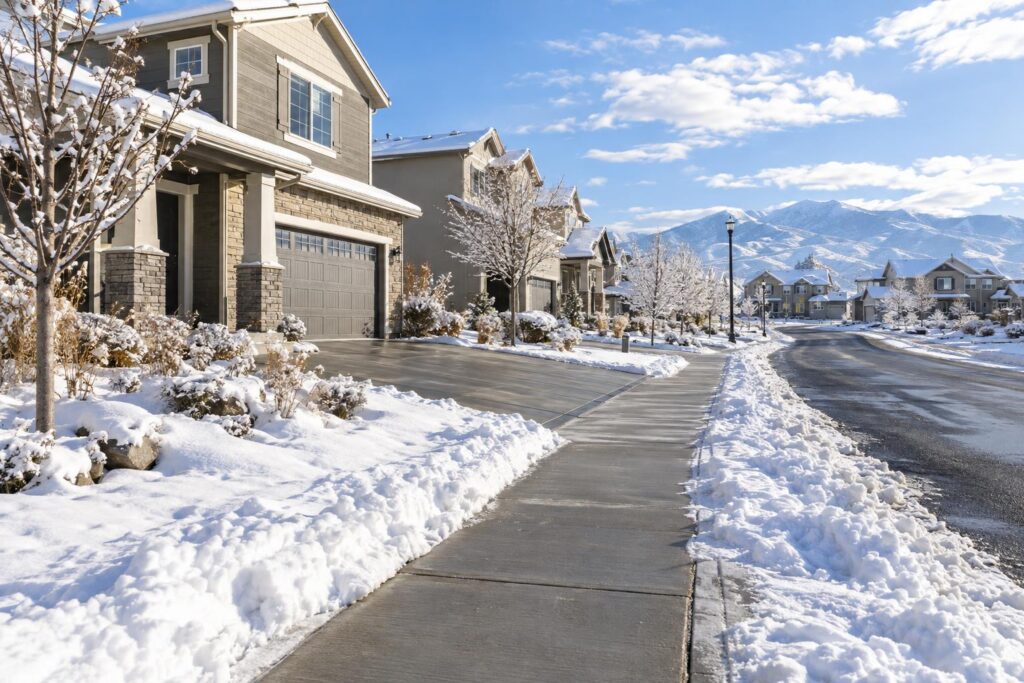
The published operational guidance assigns owners responsibility for adjacent sidewalks and driveway windrows—the snow ridge that plowing can leave at a driveway opening. It also calls attention to access around hydrants and mailboxes and directs cleared snow onto private areas rather than public roads.
Walk the frontage during an authorized visit. How much sidewalk borders the property? Where does the driveway meet the road? Where could cleared snow be placed without creating a new access problem? A corner configuration or longer frontage may change the amount of work even when the house itself is similar to another option.
Check whether snow storage could conflict with the entry route, a mailbox, or another feature you need to reach. Do not make changes around public infrastructure without checking the relevant guidance. The practical question is whether you have a workable maintenance plan for the property as it exists.
Ask where bins and other movable obstructions are normally kept. The city’s guidance asks residents to remove street obstructions so plowing can proceed. A storage arrangement that keeps those items out of the way is worth considering before the weather turns.
| Area | Starting responsibility question | Property check |
|---|---|---|
| Public roadway | What does the published priority map show? | Confirm the exact street; do not assume a plow time |
| Adjacent sidewalk | What owner duty applies here? | Measure the frontage and plan access and snow storage |
| Driveway and plow ridge | Who will clear it? | Check shape, usable parking, and the entry route |
| Hydrant and mailbox access | What clearance guidance applies? | Identify their locations and avoid blocking access |
| Private or HOA area | What does the actual contract cover? | Request written service boundaries and contact details |
Read “snow removal included” more closely
If a listing says an HOA handles snow, ask which surfaces it handles. Shared drives, private roads, individual driveways, sidewalks, steps, and small entry landings are not interchangeable terms.
Request the service scope and ask about any trigger, limitations, or owner responsibilities. Does the service address only accumulation, or are there separate questions about ice treatment? Who handles the area immediately beside the door? What should an owner do if a vehicle blocks access when service arrives?
These are questions to ask, not promises about what any Herriman association provides. The answer must come from the property documents or current service arrangement. A general description of low-maintenance living cannot establish the boundary.
Also identify how changes are communicated. If the service contractor or scope changes, you need to know where the current information is available. Keep that contact with your move-in information rather than relying on an old listing description.
Decide how much winter work you want to own
There is no single best driveway or maintenance arrangement for every buyer. Consider your schedule, preferred amount of outdoor work, available storage, and willingness to arrange paid help. Those are personal choices, not assumptions based on age or household type.
If you plan to hire a service, ask about availability and scope before treating that as a solved problem. If you plan to handle the work yourself, consider where equipment will be stored and how you will reach it. The equipment plan should fit the property.
My Herriman public-services guide can orient you to local resources. For this purchase, keep the focus on the surfaces and responsibilities at the address you are considering.
Bring a responsibility sketch to the showing
You do not need a technical drawing. On a simple note, identify the roadway, driveway, sidewalk frontage, entry steps, mailbox, hydrant if relevant, and any shared paved area. Mark the responsible party only when you have a reliable answer.
For an unknown area, write a question instead of guessing. “Who clears this shared connection?” is useful information to bring to the association contact. “Probably included” is not a maintenance plan.
During the authorized showing, compare the sketch with how you would use the property. If equipment is stored at the back of the garage, can you reach it with your vehicle parked? If you need paid help, which surfaces would you ask the provider to include? If the entry has a separate landing, is that covered by the arrangement you are considering?
Keep the answers with the current documents and service contacts. When a seller describes what they usually do, distinguish that personal routine from a legal obligation or contracted service. Both can be helpful, but they answer different questions.
The sketch also makes a fair comparison between homes easier. Two properties with similar interior space may leave you with different amounts of frontage, different parking constraints, and different service boundaries. Those are concrete tradeoffs you can evaluate before choosing.
What people get wrong about snow season in Herriman
“Once the plow comes, my access is finished.”
Roadway work can leave a driveway ridge, and it does not complete the owner’s sidewalk or entry tasks. Plan the full route from road to door.
“An HOA fee means every surface is covered.”
Only the actual service scope can answer that. Ask about the specific driveway, sidewalk, steps, and shared areas instead of relying on a broad label.
“A priority map tells me exactly when the street will be cleared.”
It identifies priorities, not a guaranteed arrival time. Conditions and operations can affect the sequence.
“A big driveway automatically solves winter parking.”
Check its usable space, your vehicles, storage, snow placement, and applicable rules. Size alone does not establish a workable arrangement.
Before the first storm
What should go on my move-in checklist?
Record the responsible contacts, parking rules, snow-service boundaries, equipment or service plan, and the places that must remain accessible. My local moving checklist helps organize the other transition tasks.
Can I rely on the seller’s description of snow service?
Use it as a starting point, then request the current written scope and confirm any area important to you. The service arrangement can matter more than the marketing phrase.
Photograph or note the relevant service boundaries only with appropriate permission during the showing.
Moving to Herriman and planning for your first winter?
Send me the homes you’re considering. I’ll help identify the driveway, parking, sidewalk, and service questions to check before you choose.