Daybreak Real Estate & Housing Outlook — How to Choose the Right Home, Pocket, and Future-Fit
Are you looking at Daybreak homes and wondering which property type, village pocket, HOA setup, and future-growth area actually fits your life? That is the right question. In Daybreak, the house matters, but the system around the house matters too: trails, parks, lake access, Downtown Daybreak, transit, schools, parking, construction, and the way your normal week will feel.
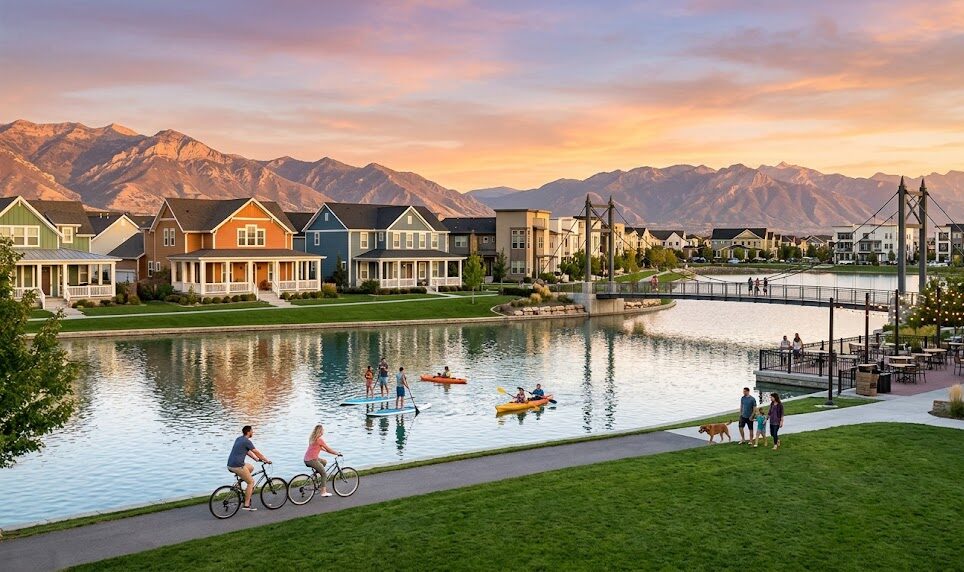
My quick answer: Daybreak real estate is easier to understand when you stop thinking only about “homes for sale” and start thinking about fit. A Daybreak home sits inside a planned community system: HOA rules, parks, trails, Oquirrh Lake, village centers, Downtown Daybreak, school routes, TRAX access, and future construction all shape the ownership experience.
The right Daybreak home should work for your life right now. Future development can make the area more convenient and more connected, but I would not buy a home that only makes sense after a future project arrives. If the address does not work today, the future promise should not rescue the decision.
This page uses official Daybreak, Daybreak Community Association, Downtown Daybreak, UTA, South Jordan, and public development resources as context. HOA fees, amenities, school boundaries, transit schedules, builder timelines, construction phases, and city plans can change. Verify the exact address before relying on any detail.
Daybreak real estate snapshot: what you are really buying
When you buy in Daybreak, you are not just buying square footage. You are buying into a master-planned community experience in South Jordan with a specific rhythm: village pockets, trails, lake access, neighborhood parks, community amenities, newer and mature housing areas, and a growing downtown district.
That structure is the reason many buyers are drawn here. It can make daily life feel more connected. It can also create decision points you would not think about in a less-planned neighborhood: HOA layers, architectural standards, amenity rules, parking limitations, density differences, and whether nearby future growth feels exciting or too busy.
The data matters, but the fit matters more. A lake, trail system, downtown district, or community center is only valuable to you if it supports the way you actually live. I want you to choose the home you will use well, not just the home that looks best during a showing.
Daybreak property types: single-family, townhome, condo, and new construction
Daybreak has a mix of housing styles, and each one comes with a different ownership feel. I would not compare them only by price. I would compare them by maintenance, privacy, parking, HOA scope, storage, future resale audience, and how much structure you want around your home.
| Property type | Often fits | What to verify before you get attached |
|---|---|---|
| Single-family homes | Buyers who want more privacy, yard use, storage, garage function, and separation from shared walls. | Lot usability, landscaping rules, snow exposure, HOA design standards, parking, nearby amenities, and future development proximity. |
| Townhomes | Buyers who want lower maintenance and are comfortable with shared walls, association rules, and tighter parking patterns. | What the HOA covers, guest parking, rental/pet restrictions, noise expectations, exterior rules, storage, and snow removal responsibility. |
| Condos | Buyers who want simplified living, lock-and-leave convenience, and potentially closer access to community nodes. | Building association documents, reserves, parking assignments, elevator/stair access, pet/rental policies, insurance coverage, and move-in rules. |
| New construction | Buyers who want newer systems, current finishes, builder warranties, and are comfortable with build timelines or nearby construction. | Timeline, upgrade scope, builder contract details, warranty terms, lot orientation, phase adjacency, HOA costs, and what is still unbuilt nearby. |
| Newer resale | Buyers who want a newer home but prefer to see an established street, completed landscaping, and actual parking patterns. | Inspection findings, HOA compliance, property condition, prior upgrades, maintenance history, and whether future nearby growth changes the feel. |
Question: Is new construction better in Daybreak?
Not automatically. New construction can be a great fit if the timeline, location, builder details, HOA structure, and surrounding phases work for you. But I would not choose new simply because it is new. I would choose it because the current address and the transition period make sense.
Question: Are townhomes and condos easier?
They can be easier from a maintenance standpoint, but they often require more comfort with rules, shared areas, parking policies, and association documents. “Lower maintenance” does not always mean “fewer decisions.”
HOA and association fit: treat it as part of the product
In Daybreak, the HOA is not just a fee. It is part of the lifestyle system. It can support amenities, community standards, shared maintenance, parks, pools, trails, community spaces, and the consistent neighborhood feel many buyers like. It can also affect what you can change, where you can park, what pets or rentals are allowed, and how much flexibility you have as an owner.
One official Daybreak HOA explainer published in 2025 listed Daybreak’s Master HOA at $142.50 and noted that average Utah HOA fees can range from $50 to $250 per month. I would treat that as context, not a quote for your property. Current fees, sub-association fees, condo/building fees, and special assessments must be verified for the exact address.
Daybreak’s official Community Association page lists resident benefits such as fiber-to-the-home internet, community and fitness center, swimming and splash pools, neighborhood parks, trails, sports courts, soccer fields, and resident boating privileges on Oquirrh Lake. A separate Daybreak HOA explainer discussed HOA fee context. Always verify current fees and documents for the exact listing.
| HOA question | Why it matters | What I would verify |
|---|---|---|
| What does the fee cover? | You need to know whether you are paying for amenities, internet, maintenance, landscaping, exterior items, or shared spaces. | Master HOA fee, sub-association fee, condo fee, coverage list, reserves, assessments, and what the owner still maintains. |
| What exterior changes need approval? | Daybreak’s consistent look is part of the appeal, but it can limit quick changes. | Fencing, paint, landscaping, solar, sheds, patios, lighting, holiday decor rules, and architectural review process. |
| What are the parking rules? | Parking affects hosting, guests, teenagers, multi-car households, and daily convenience. | Garage use, driveway rules, street parking, guest parking, overnight restrictions, RV/trailer/storage rules, and enforcement. |
| Are there rental restrictions? | Rental rules can affect flexibility and future resale audience. | Short-term rental restrictions, long-term rental caps, owner-occupancy requirements, lease minimums, and approval processes. |
| Are there multiple association layers? | A townhome, condo, or village pocket may have additional fees and rules beyond the master association. | All governing documents tied to the parcel, building, unit, or phase — not just the master HOA summary. |
Pocket selection: why two Daybreak homes can feel completely different
Daybreak is not one uniform experience. A home near Oquirrh Lake may feel different from one near Downtown Daybreak, a village center, a school route, a major access road, a quiet park pocket, or an active construction phase. Two similar homes can have very different daily-life outcomes.
This is where I slow buyers down. The listing may show bedrooms, bathrooms, square footage, and price. It will not show how parking feels on a Friday night, whether the trail access is actually convenient, or how your route changes during school pickup.
| Pocket factor | What it changes | How to test it |
|---|---|---|
| Walkable repeatables | How often you actually use trails, parks, lake paths, dining, or community spaces. | Walk from the exact front door to the places you imagine using weekly. Time it. Notice crossings, shade, lighting, and slope. |
| Activity level | Whether the area feels lively, busy, noisy, quiet, or tucked away. | Visit on a weekday morning, weekday evening, weekend afternoon, and event window if relevant. |
| Parking pressure | How easy it is to host, load groceries, manage teenagers, or park extra vehicles. | Read HOA rules and visit after work hours when residents are actually home. |
| Construction proximity | Temporary noise, dust, trucks, detours, and changing access. | Check nearby phases, builder activity, city planning resources, and whether your daily route crosses active areas. |
| Downtown Daybreak proximity | More access to dining, entertainment, baseball, events, and energy — with possible traffic and parking tradeoffs. | Visit during an event and on a normal evening. Decide how close feels good, not just convenient. |
Future growth lens: how development should shape a Daybreak real estate decision
Daybreak’s future outlook matters because growth can change the first ten minutes of your day, the nearby dining options, the energy around a pocket, the value story a future buyer sees, and the short-term construction friction you may experience.
But I would separate useful growth from wishful thinking. Useful growth is documented: official Daybreak updates, Downtown Daybreak information, UTA schedules, South Jordan planning materials, recorded approvals, builder phase information, or HOA documents. Wishful thinking is “I heard something is coming” without a source.
| Growth factor | Possible upside | Buyer risk to check |
|---|---|---|
| More dining and retail | Better local errands, gathering places, and evening convenience. | Future tenant timing can change. Decide whether current options already work for your week. |
| Entertainment and events | Baseball, concerts, movies, year-round events, and a more active community center. | Traffic, parking, sound, lighting, and event-day patterns may affect nearby homes differently. |
| New housing phases | More inventory, newer product types, and potentially more services over time. | Construction, density, road changes, school demand, and incomplete landscaping can affect the transition period. |
| Transit and access changes | TRAX access and route improvements can make some commutes or events easier. | Transit is only useful if the station, schedule, transfers, parking, and final destination work for you. |
| Public planning and infrastructure | Long-range city planning can support roads, parks, trails, and land-use clarity. | Plans are not the same as completed projects. Verify timing and address-level impact. |
Downtown Daybreak: why it matters for real estate decisions
Downtown Daybreak is one of the biggest real estate context shifts in the community. It adds a more active mixed-use center with shopping, dining, entertainment, events, living opportunities, and the Ballpark at America First Square.
For the right buyer, that is a strong lifestyle fit. You may want dinner options, baseball, movies, outdoor concerts, and more energy close to home. For another buyer, the same activity may raise questions about sound, lighting, traffic, event-day parking, and whether the area feels too busy.
Downtown Daybreak’s official site highlights shops, dining, events, living opportunities, and entertainment. Its entertainment page references Salt Lake Bees baseball, movies, year-round events, family-friendly activities, and outdoor concerts. The Ballpark at America First Square official site describes the Salt Lake Bees’ new Daybreak stadium.
| Downtown factor | What buyers may like | What to verify near a home |
|---|---|---|
| Restaurants and shops | More convenient dining, errands, and “let’s just go somewhere close” options. | What is open today, what is officially announced, and what you would actually use often. |
| Ballpark and events | Local entertainment, sports, concerts, and a stronger community destination. | Event-day traffic, noise, lighting, parking, and the walking/driving route from the exact home. |
| Mixed-use living | A more urban-village feel inside Daybreak. | Whether you want more activity nearby or prefer a quieter residential pocket. |
| Transit adjacency | Potential access to TRAX for some work, event, and valley routes. | Station distance, parking, walking comfort, schedule, transfers, weather, and final destination. |
Commute and transit: test the route, not the idea of the route
Daybreak can be convenient for many households, but commute fit is exact-address specific. UTA’s schedules and maps include TRAX Red Line information, and Daybreak’s location materials reference access to downtown Salt Lake City, Silicon Slopes, TRAX light rail, Mountain View Corridor, and other transportation connections. That is useful context, but your real life depends on your actual route.
I would not rely only on map minutes. In growing areas, the first and last ten minutes can change how a commute feels. Construction, school windows, event traffic, winter weather, and parking can all change the experience.
- Test from the exact address.
Do not test “Daybreak” generally. Test the property you are actually considering. - Drive at your real departure time.
A Saturday showing route does not tell you what Tuesday morning feels like. - Test the return trip too.
The commute home can be the part that wears on you. - Try the backup route.
If one route gets delayed, will the second route still be reasonable? - Only count TRAX if you will use it.
Include station access, parking, walking distance, transfers, weather, and the last mile at your destination.
Use UTA schedules and maps for current transit information, and South Jordan planning resources for city planning and zoning context. Transit schedules, routes, road projects, and construction conditions can change.
Schools, amenities, and daily life: where the decision becomes personal
Daybreak’s amenities are a major part of the appeal: lake access, parks, trails, pools, community spaces, sports courts, and neighborhood design. Schools can also be a major part of the decision for families. But none of those should stay abstract. They need to be tested against your actual week.
For example, a trail system is wonderful if your route from the home is easy enough that you will use it. A nearby park matters if it is the park your family will actually choose. A school location matters only after you verify the current boundary and the real pickup/drop-off route.
| Daily-life factor | What people usually ask | What I would verify |
|---|---|---|
| Schools | Which school would this address attend, and could boundaries change? | Exact-address boundaries, current district tools, charter options if relevant, school route, and timing. |
| Lake and trails | Will I actually use Oquirrh Lake, trails, and walking paths? | Distance from the front door, crossings, shade, lighting, snow/ice reality, and whether it fits your habits. |
| Parks and pools | Are amenities close enough to become part of our routine? | Which amenities are closest, how access works, whether reservations apply, and how busy they feel. |
| Retail and dining | Can I do more of my errands close to home? | What is open now, what is officially listed, and whether it matches your real weekly loop. |
| Community activity | Will the area feel connected or too planned? | Your comfort with events, HOA structure, shared spaces, activity level, and neighborhood standards. |
Buyer checklist: how to compare Daybreak homes without getting distracted
If you are comparing Daybreak homes, use the same test for every property. That keeps the decision calm and prevents one pretty listing from pulling you away from your real priorities.
- Name your property-type fit first.
Decide whether single-family, townhome, condo, new construction, or newer resale actually matches your maintenance tolerance and lifestyle. - Define your top three daily routines.
Commute, school, pets, trails, gym, errands, hosting, home office, or low-maintenance living. Choose what matters most. - Read HOA and association documents early.
Do not wait until you are emotionally attached. Rules, fees, parking, rentals, pets, and exterior standards matter. - Test parking at real times.
Evening and weekend visits show what a polished showing cannot. - Walk the 10-minute radius.
See what is truly convenient from the front door. Do not assume “nearby” means usable. - Check future development near the pocket.
Look for documented sources, not rumors. Ask whether growth adds convenience or friction for your specific routine. - Verify school boundaries for the exact address.
If schools matter, confirm through official tools and test the school route during real timing. - Ask whether the home works if growth takes longer.
If a future road, store, school, restaurant, or amenity is delayed, would you still be happy living there?
Seller lens: how to position a Daybreak home without overpromising
If you are selling in Daybreak, the listing story should be specific and grounded. Buyers do not need vague phrases like “amazing lifestyle” or “highly desirable.” They need to understand why your home works, what kind of buyer it fits, and how the pocket connects to daily life.
Future development can be part of that story, especially near Downtown Daybreak, transit, trails, lake access, parks, or maturing commercial areas. But it should be framed honestly. I would rather show a buyer the current routine and documented context than make a promise about appreciation or future demand.
| Seller angle | Why buyers care | How I would frame it |
|---|---|---|
| Property type clarity | Buyers want to know whether the home fits their maintenance, privacy, and lifestyle needs. | Describe the ownership experience, not only the finishes. |
| HOA and amenities | Daybreak buyers often care about what the association includes and how the rules feel. | Provide documents early and highlight practical benefits without glossing over restrictions. |
| Pocket benefits | Two Daybreak homes can feel very different depending on location. | Explain access to trails, parks, lake paths, school routes, retail, dining, or quiet areas. |
| Future development context | Buyers want to know what may change nearby. | Use official sources and avoid promises. Explain likely lifestyle implications, not guaranteed value outcomes. |
| Parking and daily function | Practical details can make or break buyer confidence. | Be clear about garage space, driveway use, guest parking, storage, home office spaces, and traffic patterns. |
FAQ: Daybreak real estate and housing outlook
Want a calm, address-level Daybreak real estate check?
Send me the Daybreak homes or pockets you are comparing, your commute anchor, preferred property type, HOA comfort level, school needs, and how close you want to be to Downtown Daybreak activity. I’ll help you pressure-test the shortlist with a practical home-fit lens.
Reminder: Confirm HOA documents, association fees, parking rules, school boundaries, construction timelines, development plans, transit schedules, builder details, and city planning information using official sources for the exact address.