
Commuting From Herriman: Realistic Drive Times, Mountain View Corridor Access, and Bottlenecks
August 6, 2026
Real Herriman commute times via Mountain View Corridor and Bangerter Highway, not the optimistic map-distance estimate.
Read article →The commute question most buyers get wrong — and how to test the real answer before you make one of the biggest decisions of your life.
I have watched families fall in love with a Herriman home on a Saturday afternoon, make an offer on Sunday, and then — three months after moving in — tell me the commute is slowly ruining their week. Not because Herriman is far. But because they tested the drive on a clear Tuesday in July and assumed that would be their life. It is not.
The real question is not “How long is the drive?” The question that actually predicts whether you will be happy here is: “How predictable is our weekday travel from this exact address, at the times we actually leave?”
Predictability is what separates a commute you can live with from one that quietly drains you. And in Herriman — a fast-growing southwest valley community that feeds into multiple major corridors — predictability varies enormously by pocket, by departure time, and by whether school is in session.
Where do you actually go on a Tuesday morning? Salt Lake City? Draper? Lehi? A multi-site route? That answer — paired with your real departure time — is your commute anchor. Everything else follows from it. I always ask this before we look at a single listing together.
Herriman sits in southwest Salt Lake County, approximately 20–25 miles from downtown Salt Lake City and 12–18 miles from the Draper/South Jordan employment corridor. Here is what the data shows — and what it does not tell you.
Sources: US Census Bureau ACS 2023; DataUSA.io — Herriman, UT profile 2024; Utah Department of Transportation corridor data.
That figure is a mean across all Herriman residents, all times of day, all seasons. Your commute is not an average. It is a specific address, a specific departure time, a specific day of the week, in a specific season. The gap between the Census mean and your real Tuesday morning in October can be 20+ minutes each way. That is why I always ask buyers to test the actual drive — not trust the map estimate.
This is the framework I use with every buyer who is serious about a listing. It takes two weekday drive tests and it has saved more than a few families from a decision they would have regretted. Here is how it works:
If you are relocating from outside Utah, this test is non-negotiable. You do not yet have a feel for school-year patterns, peak-hour shifts, or how construction phases temporarily reshape corridors. I have seen buyers from out of state rely entirely on Google Maps — and I have also watched them wish they had not.
Herriman is not one commute experience. It is a collection of pockets with meaningfully different access to the valley’s main corridors. Two homes listed at the same price — sometimes on the same street — can produce very different weekday outcomes based on how quickly each reaches the major arterials.
| Corridor factor | What it changes for your family | How to verify it |
|---|---|---|
| First 10 minutes from your front door | How quickly you reach your main route and whether you hit signal-heavy roads, school zones, or bottlenecks before you even get going. | Drive it at your real departure time — not midday, not on a weekend. Notice what slows you down before you hit the arterial. |
| Mountain View Corridor (SR-85) access | SR-85 is the primary north-south arterial for western Salt Lake County. Pockets with quick, clean access to this road tend to have more predictable mornings — and stronger sustained resale demand. | Map the route from the exact address to your SR-85 on-ramp and test it at your actual commute time. |
| Peak-hour variability on I-15 | I-15 connects Herriman to Salt Lake City and the Lehi corridor. Its variability during school-year mornings is significant — the gap between a good day and a hard day can be 20–30 minutes. | Use the two-day, two-time test and compare your best run to your worst run. That range is your real commute. |
| Construction sensitivity | Herriman is one of Utah’s fastest-growing cities. Growth brings new roads — but also temporary corridor shifts and construction-phase friction that can add unpredictable time for a year or more. | Check UDOT’s active project map and use the Growth Outlook page for what is changing near your pocket. |
| School-year timing | School-year mornings and afternoons behave differently from summer conditions. Corridor entry friction increases noticeably when Jordan and Canyons School District schedules are running. | Test during active school weeks when possible. If you are moving in summer, ask me about school-year patterns for the specific pocket you are considering. |
Two Herriman homes at the same price can feel completely different once your family is actually living there. A home with clean access to the Mountain View Corridor will behave differently from one that requires navigating Herriman’s interior streets during school hours. I always tell buyers: test before you make an offer, not after you have already signed.
The single most useful question I ask buyers is: where do you actually go on a Tuesday? Not in theory — in practice. Your answer determines which Herriman pocket will and will not work for your family. Here is how the main work anchors play out:
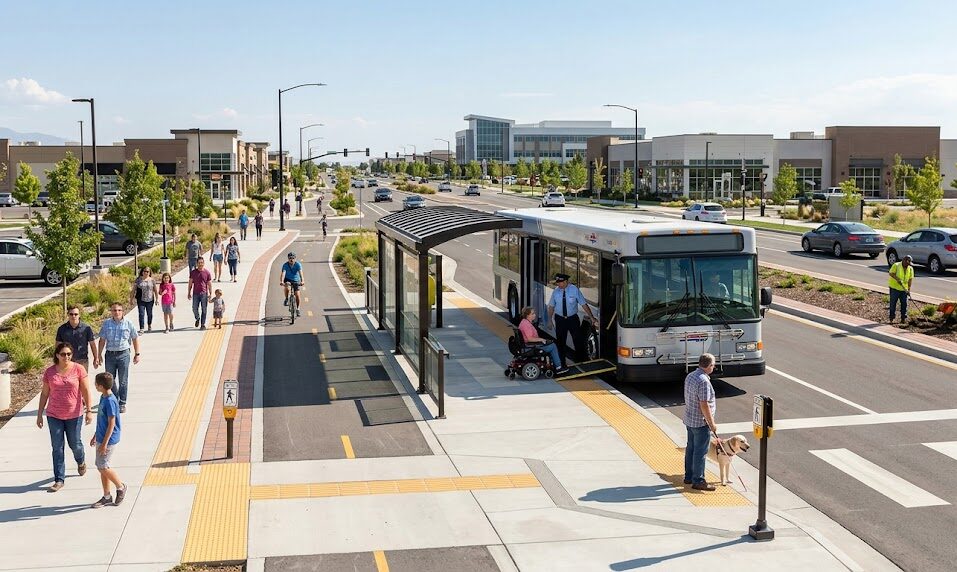
When buyers ask me about Herriman transit, they usually mean one of three things: an alternative to daily driving, a backup for when driving is harder, or safe and walkable routes for kids and family members. Let me be honest with you about each of these.
The Utah Transit Authority serves parts of the Herriman and southwest valley area with bus routes. In early 2025, UTA added new routes connecting Herriman, Riverton, and Bluffdale — Routes 126 and 219 — expanding access to the broader valley network. This is a genuine improvement from where transit stood five years ago.
However, “a route exists” is not the same as “transit works for your household.” The honest question to ask yourself is: Does the schedule match the times I actually need to travel, and can I safely walk from my front door to the nearest stop?
| Transit factor | The honest picture | How to verify for your address |
|---|---|---|
| Route coverage | UTA bus routes serve parts of Herriman but coverage is not uniform across all pockets. Some areas are well-served; others require driving to a park-and-ride. | Use the official UTA trip planner (rideuta.com) with your specific address as the starting point. |
| Schedule fit | Transit schedules are fixed. If your work start time or school pickup does not align with route timing, transit becomes impractical regardless of whether a route is nearby. | Check actual departure times for routes serving your area against your real schedule — not the best-case alignment. |
| Walk to stop safety | The walk from your front door to the nearest stop matters as much as the route itself. Sidewalk continuity, crossings, and lighting determine whether the walk is genuinely usable. | Walk or drive the route to the stop at the time you would use it. Check sidewalk continuity and crossing safety on foot. |
| Transfer requirements | Reaching downtown Salt Lake City or major employment hubs from Herriman via transit often involves at least one transfer, adding meaningful time to the journey. | Plan the full door-to-destination journey in the UTA planner and account for transfer wait time, not just travel time. |
Sources: Utah Transit Authority (rideuta.com) — route maps and schedules current as of early 2026; UTA community input process 2025.
If driving is your primary mode and you want transit as an occasional backup — it is viable and improving. If you are hoping to be car-free or significantly car-light in Herriman, I want to have an honest conversation with you before you make any decisions. It is not impossible, but it requires very careful pocket selection and schedule alignment. Call me and we can talk through it specifically.
If your household has school-age children — or you are planning for them — your commute is not one route. It is a system. And that system breaks when drop-off timing collides with your work start, when pickup windows compress your afternoon, or when after-school activities add trips you did not plan for.
I call this the two-routine decision: your work commute and your school commute need to fit together as a system, not just individually. I have watched this catch families off guard more than almost anything else in the Herriman buying process.
Even if you do not have children, school-year traffic affects corridor timing across Herriman. The Jordan and Canyons School District schedules create predictable morning and afternoon friction on interior roads and corridor entry points. If you are evaluating a home in summer and planning to commute, ask me about what that specific pocket looks like in September before you decide.
Herriman is a car-dependent community by design — most daily needs require driving. But walkability still matters for your family in ways that go beyond running errands on foot. It affects whether your kids can safely walk or bike to school or a park, whether a family member with mobility needs can move around independently, and whether the neighbourhood simply feels comfortable to be outside in.
Herriman’s rapid growth means newer developments often have more complete sidewalk networks than older sections of the city. If walkability matters to your family, this is worth factoring into which pocket you focus on — and it is something I can help you evaluate for specific addresses.
If anyone in your family has a vision impairment, mobility limitation, or is planning to age in place, treat accessibility infrastructure the way you treat a home inspection — as a systematic check, not an assumption. The home itself may be perfect, but the routes from your door to the places you need to reach regularly are part of what makes a home genuinely livable long-term.
| Accessibility factor | Why it matters | How to verify it |
|---|---|---|
| Curb ramp continuity | Gaps in curb ramps create “no route” situations even when distances are short and sidewalks are otherwise present. | Walk or roll the route — do not rely on street view images, which may be outdated. |
| Crossing signals and timing | Crossings without adequate signal time or with unclear sight lines can be barriers even when crosswalks are marked. | Cross at the actual points you would use, at the times you would use them, and assess signal timing and traffic speeds. |
| Surface grade and smoothness | Steep grades and uneven surfaces affect wheelchairs, walkers, and strollers significantly. | Test the route, not just the map distance. Grade is not captured in distance estimates. |
| Transit stop walkability | A transit route is only accessible if you can safely reach the stop from your door. | Walk the route to the nearest stop and assess continuity, lighting, and crossings along the way. |
Source: UDOT pedestrian infrastructure reports; ADA accessibility standards; Jordan School District safe routes to school program.
I want to be direct about something that gets glossed over in most home searches: your commute is a financial decision, not just a lifestyle preference. Two families with identical incomes can experience very different effective affordability in Herriman based entirely on where they work and how predictable their commute is.
Mortgage + HOA (if applicable) + utilities + insurance + vehicle costs + commute fuel + any childcare timing adjustments = your actual monthly housing cost. A home that looks $200 a month cheaper on paper can cost more over five years if it adds 40 minutes of daily commute time to a schedule that was already tight. I have seen this play out in real families’ lives. Please build the full number before you make an offer.
The ways commute friction turns into real cost are often invisible until you are living them:
Use the Herriman Housing Costs page to build your full monthly picture — including HOA, utilities, and insurance — then add your commute cost estimate on top. That combined number is your actual affordability ceiling, not the mortgage figure alone.
Google Maps on a Sunday afternoon is not your commute. Your commute is Tuesday at 7:45am in September when school just started and I-15 is backed up past Draper. The gap between those two can be 20–30 minutes each way — more than 200 hours of your life every year. Test the real drive before you make an offer.
This is the most common pattern I see. Families fall in love with a floor plan, make an offer, and then figure out the commute. By then, they are emotionally committed and the drive becomes a problem they live with instead of a filter they used. I ask about your work anchor before we look at a single listing — because the commute should be a filter, not an afterthought.
If you are evaluating a home in summer, you are seeing a best-case version of the commute. School-year mornings in Herriman are a different experience. If you are moving in July, ask me what the corridor looks like in October. I will tell you honestly.
A UTA route existing near your home does not mean it fits your schedule, your stop is safely walkable, or that the journey time is realistic for your day. Verify all three — schedule fit, stop access, and total journey time — before you count on transit as part of your plan.
If anyone in your household has mobility needs — now or in the foreseeable future — sidewalk gaps, missing curb ramps, and steep grades can turn a beautiful home into one that does not actually work for your family. Check the routes before you close, the same way you check the home inspection report.
What happens when your car is in the shop, a corridor is closed for construction, or your schedule shifts? The households that handle disruption well are the ones who thought through a backup before they needed it — whether that is a carpool arrangement, a transit option, or a pocket with enough route flexibility to adapt.
Everything your family needs to make a well-rounded decision about Herriman — from schools and the economy to safety and future development.
Share your work anchor — Salt Lake City, Draper, Lehi, or multi-site — your real departure time, and whether school timing is part of your week. I will help you apply the two-day, two-time framework to your shortlist and identify the pockets that actually work for your family. No pressure. Just an honest conversation from someone who has been in this market for 36 years.
Reminder: Verify commute routes, transit schedules, school boundaries, pedestrian infrastructure, and accessibility details using official sources and real-world testing for the exact address.